App fees keep rising, manual work keeps growing, and someone on the team holds their breath before every update. We help you find what really slows the store down and whether simplifying it is enough.
If you recognise three or more of these situations, your store has probably outgrown its current setup.
A weekend promotion means changes in three apps, then someone manually fixes whatever did not sync.
Before updating a plugin or theme, you take a backup and wait to see what breaks.
Every month you pay for apps that nobody can fully list or justify any more.
Wholesale, unusual or custom-priced orders run through email and spreadsheets because the store does not support them.
Every morning someone checks whether orders and stock made it to the warehouse or ERP.
Only one person, a freelancer or an agency, knows how everything is connected.
A new sales or marketing idea ends with: “we can’t do that without another app”.
You know something has to change, but not whether a clean-up is enough or you need a new platform.
Same symptoms. Different platforms.
Each of these platforms works well at its stage. After years of growth, the problems look similar, even if they start in different places.
Shopify
New features arrive as paid apps, each with its own subscription and its own data.
WooCommerce
Dozens of plugins, and every WordPress update needs testing before it reaches production.
BigCommerce
Custom checkout or pricing logic ends up split across apps, scripts and platform limits.
Magento
Upgrades and extensions need a specialist team, and maintenance costs are hard to predict.
PrestaShop
Modules and core overrides make every version upgrade feel like a new implementation.
It’s not the platform’s fault. Your store simply grew.
Shopify, WooCommerce, BigCommerce, Magento and PrestaShop are good tools for launching and growing. Every app and plugin once solved a real problem.
After a few years, that same layer of add-ons becomes the problem: one process runs through several tools, and every change means checking what might break along the way. Fees are only part of the cost. The rest shows up in manual work, maintenance and the changes nobody wants to touch.
First we understand your store. The decision comes later.
We don’t start with a platform recommendation. We start with how your sales actually work.
We map dependencies. Which apps handle key functions, how data flows and where the team works manually.
We calculate the full cost. Not just subscriptions, but also operations, maintenance and the changes you keep postponing.
We point to a direction. Simplify the current store, plan a phased migration or leave it as it is.
Leaving the store as it is counts as a legitimate outcome. Not every store needs a migration.
Simplify or migrate in phases?
Both roads are a legitimate outcome of the diagnosis. Tick what fits your store and see which way it leans.
Simplify your current store
Makes sense when
The platform handles your main sales process well.
The problem sits in a few add-ons, not the whole store.
The cost of further changes is acceptable.
A legitimate outcome of the assessment. Not every store needs a migration.
Migrate in phases
Makes sense when
A critical process stays blocked.
One process runs through several apps and manual workarounds.
Comparing costs and risks justifies the change.
Migration has its own cost and risk. It should follow from a real problem.
Compare both roads with the same calculation.
Full cost = implementation + 24 × monthly costs + planned changes. We calculate it separately for tidying up and for migrating.
Road
Implementation
24 × monthly costs
Planned changes
Simplify your current store
Configuration clean-up, replacing or removing add-ons
Subscription, add-on fees and manual work
Changes within the platform and its add-ons
Migrate in phases
Medusa implementation and data migration
Hosting, maintenance, updates and security
Building your own features and integrations
On both sides we include hosting, add-ons, maintenance, updates, security, integrations and support. Custom code needs maintenance too.
If migration makes sense, we propose Medusa. Delivered in phases.
Medusa is an open e-commerce platform where features are built around your processes, not around a list of available apps. We don’t move your store over one weekend. We plan functions, integrations, data and operation, then move them piece by piece.
Medusa also needs hosting, integrations and maintenance. Custom code needs maintenance too, so we include it from the first conversation.
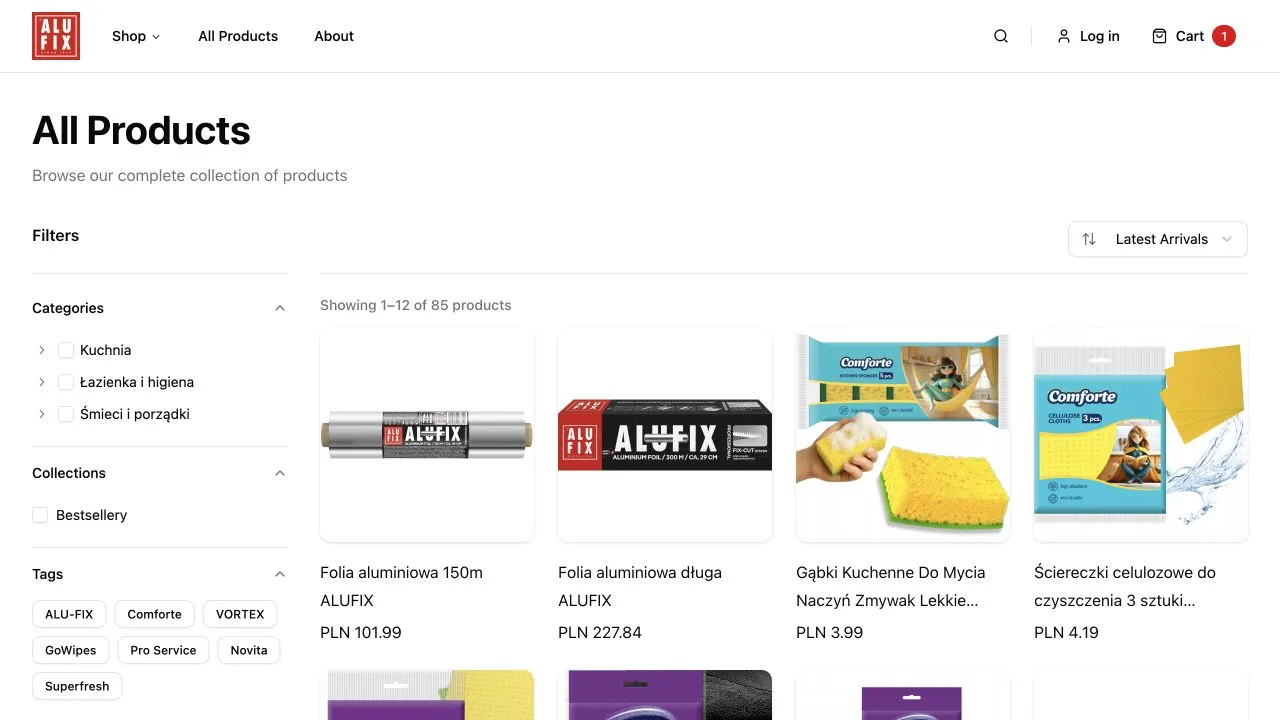
A complete purchase on Medusa. Explore Alufix.
We designed and implemented the Alufix store from catalogue and search to cart and purchase. You can inspect the real interface and working journey.
We contribute directly to Medusa. Piotr Graczyk and Paweł Stalęga connect business decisions, architecture and implementation quality. AI and our reusable code support the work; we remain accountable for the result.
Before you decide on a migration, let’s see what is really blocking your store.
20 minutes online. We discuss key apps, approximate costs and one change that recently proved difficult. You leave with an initial direction: simplify the current store, prepare a phased migration or change nothing. If migration makes no sense, we will tell you plainly.
A list of your key apps or plugins, approximate fees and one example of a difficult change is enough.
When this conversation helps
This is for stores already feeling the cost of apps, workarounds and difficult changes. If your current platform supports your process and changes remain affordable, we will say so plainly. A migration is not needed then.
Will you push us towards a migration?
No. We compare both roads with the same calculation. If cleaning up the current store is the better outcome, that is what we recommend.
Does Medusa mean no add-ons and lower costs?
No. Medusa also needs integrations, hosting, development and maintenance. We compare total cost and control over required functions. Migration has its own cost and risk and should address a real problem.
What happens after the first conversation?
This is an initial conversation, not a full audit. If deeper analysis is needed, we agree a separate paid e-commerce implementation plan: 5 working days for a defined scope, €2,500 net.
Your cookie choices
Evelumo uses essential storage to remember your choice. With your consent, Google Analytics and PostHog help us understand how you use this website. Rejecting analytics does not limit access to the website.
Your browser cannot save these settings. Your choice applies to this page, but we will ask again on your next visit.