
Live e‑commerce in 30 days
We build it on our foundation and fit it to your business and your processes. 30 days after kickoff, your store runs on your domain and takes orders.
20 minutes online. You get a straight answer: buy, build or drop it.

- Day 7: a store you can click through
- Day 14: your catalogue and prices
- Day 21: payments, shipping, your brand
- Day 30: the store takes orders
- Timeline
- 30 days from kickoff
- Price
- from €5,000 net, fixed before kickoff
- Sales
- B2B and B2C
- After launch
- hosting and maintenance from €100 net a month
You own your store's code. We own the launch in 30 days.
Who the 30‑day offer is for
You need a date, not a roadmap
You are starting online sales or opening a new channel, and you need a store that takes orders. The 30 days are written into the offer.
You sell to companies and to consumers
Company accounts with their own price lists and a retail store with promotions run on one catalogue, not in two systems.
Your platform blocks the next change
Every new pricing rule or order flow needs another app or a workaround, and the fees grow with your revenue.
You want to own your store
The code written for your store is yours, on an open source platform your team can read, extend and take over.
What runs on day 30
A store in production on your domain, taking real orders.
A store in your brand
The storefront comes from our foundation and is fitted to your brand and your catalogue. Catalogue, cart, checkout and orders work from the first day of the build.
Payments and shipping
Customers pay and pick a delivery method in the checkout. Your team sees every order in the admin panel.
Company accounts and price lists for B2B
A business customer logs in to a company account and sees their own prices.
Promotions and discount codes for B2C
You set up promotions and codes for retail customers in the admin panel.
An admin panel for your team
Your people manage products, prices, orders and customers themselves.
Hosting, monitoring and your code
The store runs on hosting we set up and monitor from day one. The code written for your store belongs to you.
How the 30 days run
Below is the usual order of work. What stays the same is the rhythm: you see a working store during the build and test it on your own sales scenarios, not only at acceptance.
The store is live on your domain and takes real orders.
A diagram of the usual order of work, not a screenshot of a client's store.
Day 30 of 30
Days 1–7
Kickoff and a store you can click through
We agree the scope and the acceptance criteria and set up your store on our foundation. Catalogue, cart, checkout and orders already work, so you review a running store, not a document.
Your part A kickoff session, your product data and your brand assets.
Days 8–14
Your catalogue and your prices
Your products, categories and prices go in. We set up company accounts and customer price lists for B2B, and promotions and discount codes for B2C.
Your part Checking prices and customer groups against how you really sell.
Days 15–21
Payments, shipping and your brand
We connect payments and shipping and finish the storefront in your brand. You place test orders on your own sales scenarios.
Your part Your payment and carrier accounts, and test orders.
Days 22–30
Acceptance and launch
We test the critical paths, a second expert reviews the changes, and we go through the acceptance criteria with you. The store goes live on your domain and takes real orders.
Your part Sign-off against the acceptance criteria and access to your domain.
Works by now
- Catalogue, cart, checkout and orders
- Your products, categories and prices
- Company accounts and customer price lists
- Promotions and discount codes
- Payments and shipping
- A storefront in your brand
- The store on your domain
When you first see a working store
A handoff-led model
- Brief
- Specification
- Build
- Acceptance
You test the working journey only at acceptance.
30 days with Evelumo
- Days 1–7
- Days 8–14
- Days 15–21
- Days 22–30
You test a working store on your own sales scenarios during the build.
What the starting price covers and what changes it
€5,000 net is where a live store on our foundation starts. Before kickoff you get your own amount as a fixed price for an agreed scope, not an hourly rate.
In the starting price
from €5,000 net
- a store in production on your domain
- a storefront in your brand: catalogue, cart and checkout
- payments and shipping
- company accounts and customer price lists for B2B
- promotions and discount codes for B2C
- an admin panel for your team
- hosting and monitoring
What raises the price
- how your B2B prices are calculated
- sales logic the foundation does not cover
- the number of markets
- the scope of the interface design
Quoted separately, at a fixed price
- ERP integration, added after launch once the data is mapped
- moving data, redirects and integrations from an existing store, after an audit of that store
- new features, markets and integrations after launch
After launch, hosting and maintenance start from €100 net a month. The hosting bill depends on your traffic and the provider.
Get your fixed price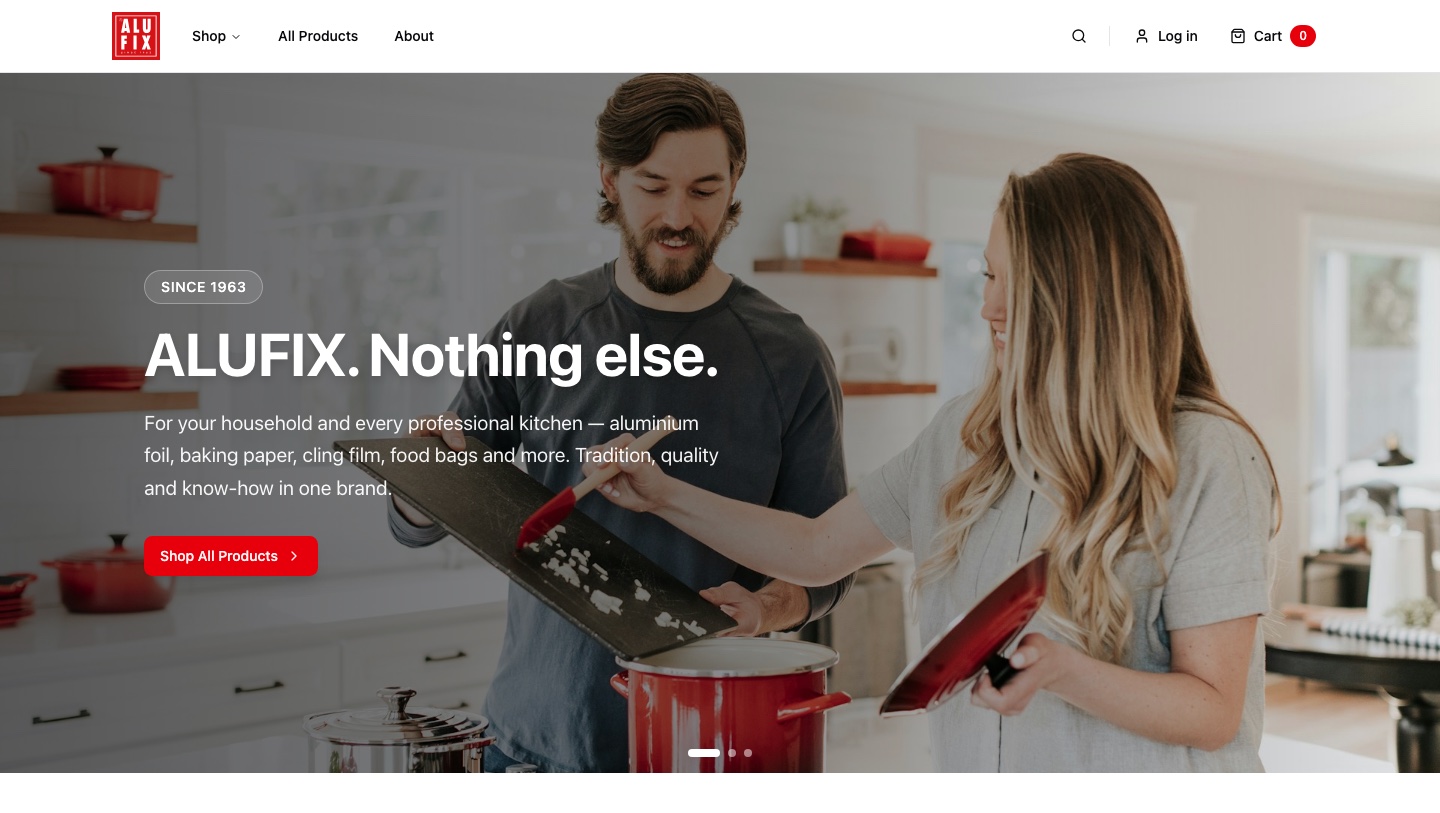
Alufix: a Medusa.js store you can open and check
We designed and built this store on Medusa.js with a custom Next.js storefront: a catalogue of seven brands, product variants, a cart and a checkout for consumers and companies. Open it and follow the path from a category to the checkout.
Read the case studyAfter day 30 we stay
Launch is the start, not the handover. We keep developing the store around what your customers need, in stages with an agreed scope and a fixed price.
This is when ERP integrations come in (SAP, Microsoft Dynamics 365, Oracle NetSuite, Comarch ERP, JTL-Wawi and others), along with new markets and new features.
Hosting and maintenance start from €100 net a month.
- Day 30: live store
- ERP integration
- New markets
- New features
The store is yours, with no lock-in to us
The code written for your store belongs to you. You use our foundation under a perpetual, royalty-free licence.
Medusa's core is open source under the MIT licence, so you pay no licence fee and no share of your revenue. If your store needs Medusa's paid Enterprise features, such as RBAC or SSO, we tell you before you sign.
It is open TypeScript code that your team can read, extend and take over.
From the first call to kickoff
A 20‑minute call
You tell us how you sell and what you want to change. We spend 30 to 60 minutes preparing before we talk.
A straight recommendation
Buy an off-the-shelf platform, build on our foundation, or leave things as they are. We say which one we would choose in your place.
Scope and a fixed price
You get the scope and a fixed price before kickoff. There is no paid analysis or planning stage before the build.
Kickoff
The 30 days start when the work starts, after the contract is signed.
Questions about launching in 30 days
How much does a store in 30 days cost?
Pricing starts from €5,000 net for a live store on our foundation. The amount depends on your sales model and how much fitting it needs. We confirm it as a fixed price before kickoff, so you approve an amount for an agreed scope, not an hourly rate.
What is included in the starting price?
A store in production on your domain: a storefront in your brand with catalogue, cart and checkout, payments and shipping, company accounts and customer price lists for B2B, promotions and discount codes for B2C, an admin panel for your team, and hosting and monitoring.
What is not included?
ERP integration and moving an existing store. Integrations are added after launch as separately scoped work, quoted at a fixed price once the data is mapped. Moving data, redirects and integrations from an existing store is quoted at a fixed price after an audit of that store.
Is there a paid analysis before the build?
No. The first step is a free 20-minute call that ends with a recommendation: buy an off-the-shelf platform, build, or leave things as they are. There is no paid analysis or planning stage before the build.
When do the 30 days start?
At kickoff, after the contract is signed. After 30 days the store runs in production on your domain and takes orders.
What do you need from us?
One person who makes decisions about the store and reviews the working versions, your product data and prices, your brand assets, your payment and carrier accounts, and access to your domain.
Can you handle B2B and B2C at the same time?
Yes. The foundation supports both models in one store: company accounts and price lists for business customers, and promotions for retail customers.
We already have a store. Can you move it in 30 days?
The 30 days and the starting price cover the new store. Moving data, redirects and integrations from your current store is scoped separately, after an audit of that store, and quoted at a fixed price.
Can the store be connected to our ERP?
Yes, after launch. A store can go live before it is integrated with the ERP. We add the integration as separately scoped work, quoted at a fixed price once the data is mapped. We integrate with SAP, Microsoft Dynamics 365, Oracle NetSuite, Comarch ERP and JTL-Wawi, among others.
What do we pay after launch?
Hosting and maintenance start from €100 net a month. New features, new markets and new integrations are priced as separate work. Medusa's core is open source under the MIT licence, so there is no licence fee and no revenue share.
Who owns the code?
The code written for your store is yours. You use our foundation under a perpetual, royalty-free licence. Medusa is open TypeScript code, so your team can read it, extend it and take it over.
What happens after launch?
We stay with you. For us, launch is the start, not the handover. We keep developing the store around what your customers need, open new markets with you, and work on growing your sales.

Let's start selling in 30 days.
In a 20-minute call, tell us how you sell. We will show you what a 30-day launch looks like for your business and what it will cost.