
Headless commerce development for companies whose sales do not fit a theme
Headless commerce separates the storefront your customers see from the commerce engine that holds products, prices and orders, and connects the two through an API. We build both sides: the engine on Medusa.js and the storefront in Next.js, around the way you sell.
20 minutes online. You get a straight answer: buy, build or drop it.

- Storefront
- B2B portal or app
- One commerce engine
- Engine
- Medusa.js (open source)
- Storefront
- Next.js, built for your buying path
- First store
- Live in 30 days, from €10,000 net
We contribute to Medusa and show a working headless store built on it.
When headless commerce makes sense

The theme is the limit
The buying path you need, such as a configurator, a quote request or a customer-specific catalogue, does not fit your platform’s theme and checkout.
More than one front end
A store, a B2B portal, a mobile app or a kiosk should sell from one catalogue, one set of prices and one order flow.
Your systems run the process
ERP, PIM or WMS own prices, stock and orders, and the store has to follow them through an API, not through file exports.
Changes without a platform release
You want to redesign or test the storefront without touching the commerce engine, and change the engine without rebuilding the storefront.
What you get
A commerce engine on Medusa
Products, prices, cart, orders and customers run in Medusa and are available through an API. We separate what Medusa provides, what comes from our implementation base and what has to be written for you.
A storefront built for your buying path
We design and build the storefront, usually in Next.js, around how your customers actually buy: from categories and search to cart and checkout.
Your sales logic in the engine
Pricing, roles, order and availability rules live in the back end, so every front end gets the same answer.
Integrations through the API
We connect payments, shipping, ERP, PIM and other systems to the engine, so data flows without manual exports.
An admin your team can use
Your team manages products, prices and orders in the Medusa admin, extended with the views and actions it needs day to day.
Code you own
The store’s code is yours, with production deployment, monitoring and documentation. After launch, we keep developing the store in stages.
How we work
Conversation
20 minutes with the founders: how you sell, what you want to change and whether Medusa fits the project.
Scope and fixed price
We agree the first stage and quote it at a fixed price. A live store on our foundation launches in 30 days.
Working increments
We show each stage on your own sales scenarios, not only at acceptance.
Release
We test the critical paths, move the data and launch the store following a cutover plan.
Growth
After launch, we develop the store in further stages, each with an agreed scope and price.
Technology
We build the engine on Medusa and the storefront in Next.js. We choose the rest of the stack to fit the project, its integrations and your plans.
- Medusa
- Next.js
- Node.js
What headless commerce means in practice
On a traditional platform, the storefront is a theme inside the same system that stores products and orders. You change it within the limits the platform sets. In headless commerce, the storefront is a separate application that asks the commerce engine for products, prices and carts through an API.
For the business, this means the buying path is no longer shaped by a theme, and a second front end, such as a B2B portal or a mobile app, can sell from the same engine. The cost is real too: there are two applications to build, host and maintain. This is why we check the fit before we propose headless ecommerce development.
| Area | Traditional platform | Headless commerce |
|---|---|---|
| Storefront | A theme inside the platform, changed within its limits. | A separate application, designed around your buying path. |
| Sales logic | Platform settings plus apps or plugins. | Your own rules in the commerce engine, the same for every front end. |
| Integrations | Connectors and apps, often one per system. | Direct, through the engine’s API and workflows. |
| A new channel | Usually a second store or another app. | Another front end on the same engine. |
| What you run | One system, maintained by the vendor (SaaS) or by you (open source). | Two applications: the engine and the storefront. |
| Best for | Standard selling that a theme covers. | Selling with your own rules, integrations or several channels. |
What a headless build costs, and where the money goes
A live headless store on Medusa and our foundation starts from €10,000 net and launches in 30 days. The starting price is possible because the engine, the storefront base and the deployment setup already exist, so the first stage goes into your catalogue, your buying path and your rules.
A larger scope is quoted at a fixed price after a conversation. Four things move the price most.
| Cost driver | Keeps the price lower | Raises the price |
|---|---|---|
| Front ends | One storefront. | A storefront, a B2B portal and an app. |
| Integrations | Payments and shipping. | ERP, PIM or WMS, with data flowing both ways. |
| Sales logic | Standard prices and promotions. | Customer-specific prices, approvals, quotes or availability rules. |
| Interface design | A storefront close to our base. | A buying path designed from scratch. |
Headless on Medusa, Shopify or commercetools
Headless is an architecture, not a product, so the engine behind the storefront can be different things. We build on Medusa. Before we propose it, we compare it with the route you already have in mind, and we say so when another one fits better.
| Route | When it remains a good choice | When we propose Medusa |
|---|---|---|
| Shopify with a custom storefront | Your back-office process fits Shopify, and only the storefront needs more freedom. | The limits are in the back end: pricing rules, the order flow or integrations that Shopify’s model does not cover. |
| commercetools | You want a vendor-run platform on an enterprise contract and have a team to build on it. | You want the code and the data in your own repository, on an open source core without revenue-based fees. |
| A new front end on your current platform | The engine works well, and only the theme holds you back. | The engine itself is the bottleneck, so a new storefront would not remove the workarounds. |
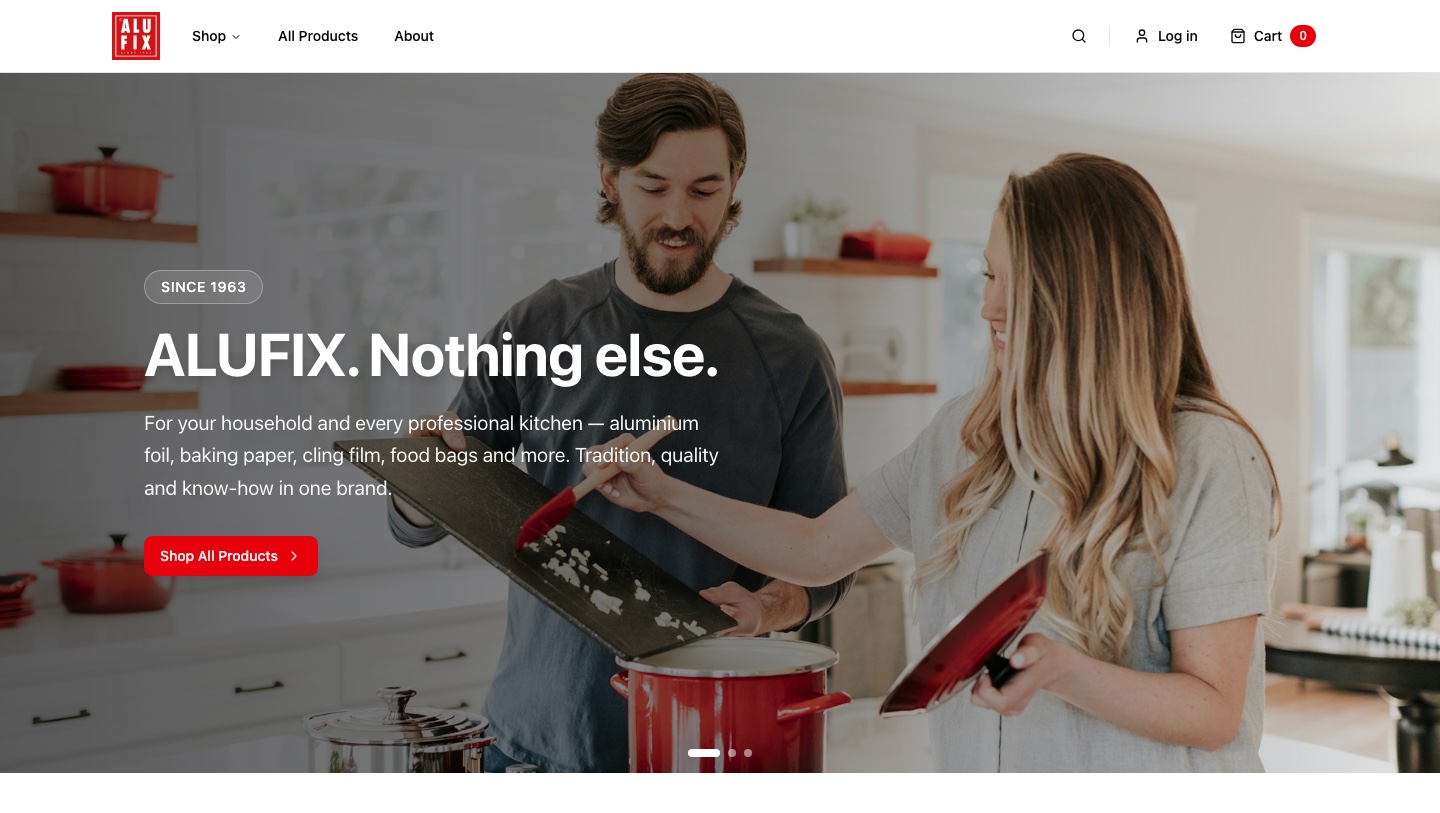
Alufix: a headless store on Medusa.js and Next.js
A store with a Medusa back end and its own Next.js storefront: catalogue, search, cart and a checkout for consumers and companies. You can open the store and check the journey yourself.
Read the case studyEngagement model: fixed price
We work at a fixed price for an agreed scope. Before we start, you know what each stage delivers and what it costs.
The price mainly depends on the number of front ends, the number and complexity of integrations, custom sales logic and the interface design scope.
A live store on our foundation launches in 30 days, from €10,000 net.
Live e-commerce in 30 daysQuestions about headless commerce
What is headless commerce?
Headless commerce is an e-commerce architecture in which the storefront (the head) is a separate application from the commerce engine that holds products, prices, carts and orders. The two talk through an API. The storefront can then be designed freely, and several front ends, such as a store, a B2B portal and an app, can use one engine.
How much does headless commerce development cost?
A live headless store on Medusa and our foundation starts from €10,000 net and launches in 30 days. A larger scope, such as several front ends, ERP integrations or a migration, is quoted at a fixed price after a conversation. The price depends mostly on the number of front ends, the integrations, custom sales logic and the design scope.
Is headless commerce worth it for a small store?
Often not. A headless store is two applications to build, host and maintain. If you sell in a standard way and a theme covers your buying path, an off-the-shelf platform will cost less to run. Headless pays off when your sales rules, your integrations or several channels do not fit a theme.
Is Shopify a headless platform?
Shopify can be used headless: you build your own storefront, for example with Hydrogen, and connect it to Shopify through the Storefront API. The back end stays Shopify, with its pricing, checkout and order model. That is a good route when only the storefront needs more freedom, and a weaker one when the limits are in the back end.
Does headless commerce help SEO?
Not by itself. Headless gives you control over how pages are rendered, how fast they load, the URL structure and the structured data, and the result depends on how the storefront is built. We render store pages on the server, so the content is in the HTML that search engines receive. We do not promise rankings.
What is the difference between headless and composable commerce?
Headless separates the storefront from the back end. Composable goes one step further: the back end itself is assembled from separate services, such as search, content, payments and product data, and each can be replaced. A headless store on Medusa is modular, so you can start with one engine and swap parts later.
Can one headless store serve B2B and B2C?
Yes. One engine can hold customer groups, price lists and sales channels, and each audience gets its own front end or its own view of the same storefront. We describe company accounts, customer pricing and quick ordering on the B2B page.
Who owns the code of a headless store?
You do. The store’s code is yours, and you get full access to the repository, the deployment and the documentation. Medusa’s core is open source under the MIT licence, so there is no licence fee or revenue share for the core.

Let’s check whether headless fits the way you sell.
20 minutes with the founders. We will tell you plainly if a platform with a theme is the better choice.