
Ecommerce website cost in 2026: SaaS vs custom build, with real numbers
Most cost guides quote ranges from a few dollars to a quarter of a million. This one uses published prices only, splits every option into build cost and running cost, and shows when a SaaS store is the cheaper answer.
Short answer
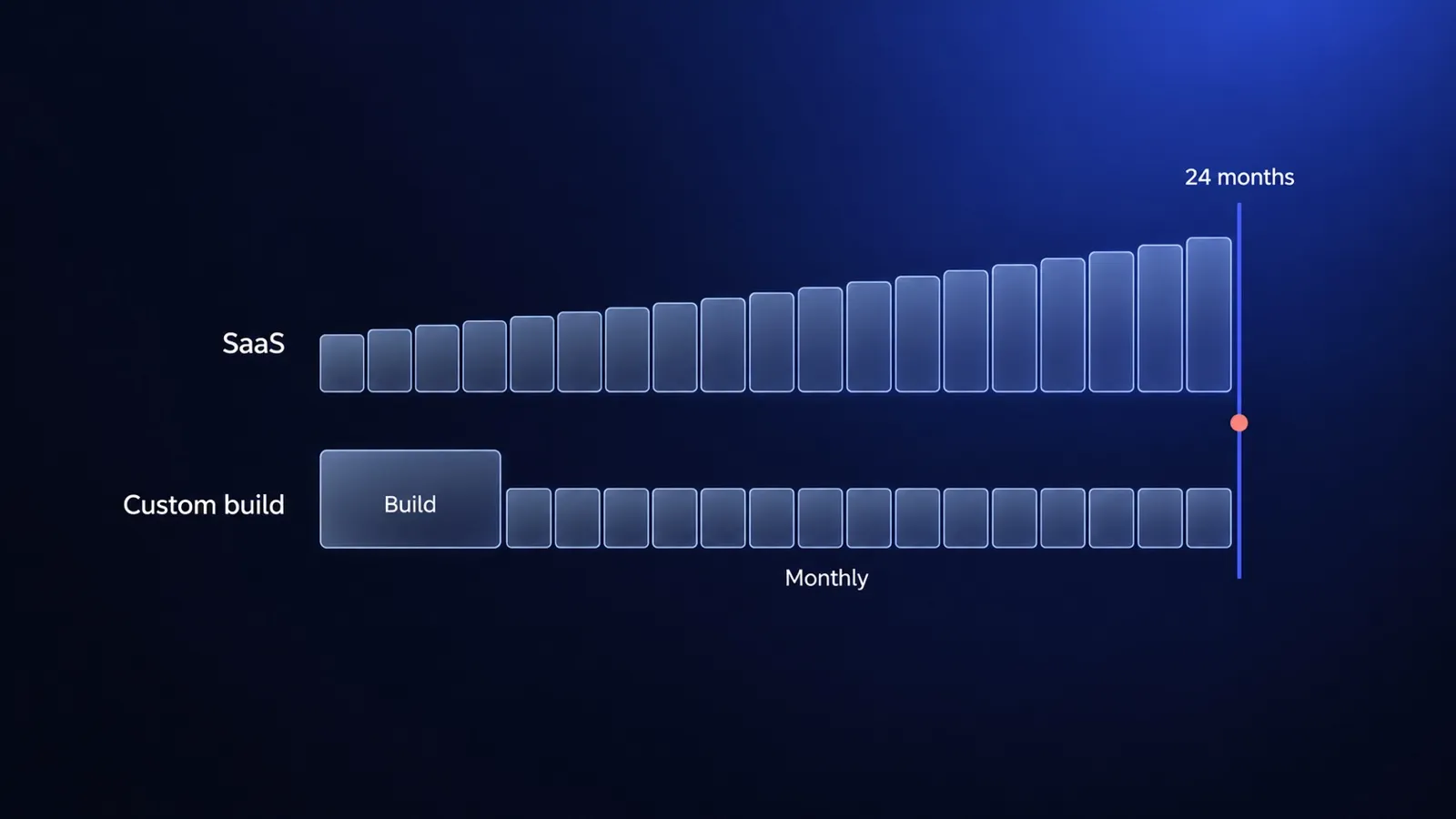
Ecommerce website cost in 2026 comes down to two numbers, a one-off build and a monthly running cost: SaaS plans start from $29 a month billed yearly (source, as of 2026-10) on Shopify Basic or $29 a month billed yearly (source, as of 2026-10) on BigCommerce Core before payment fees, apps and agency work, and a custom build on Medusa starts from €10,000 net with our live store in 30 days, plus hosting and maintenance. You can only compare SaaS with a custom build when you add both numbers up over the same 24 months and the same scope. On SaaS, payment fees, apps and agency hours grow with your revenue and with every workaround, while the running cost of a custom build depends on hosting and maintenance, not on your sales. Choose SaaS when your process fits the platform, and price a custom build when customer-specific B2B pricing, ERP integration or revenue-based fees keep pushing the SaaS line up.
How much does an ecommerce website cost in 2026?
An ecommerce website costs two numbers in 2026: a one-off build and a monthly running cost. SaaS platforms publish the monthly subscription and leave the build to you or an agency. A custom build is mostly a one-off price, followed by hosting and maintenance. The table lists only the prices someone has actually published, with the source and the date we read it.
| Option | One-off build | Monthly running cost | Published by |
|---|---|---|---|
| Shopify Basic, Grow, Advanced | Not published (theme, setup and agency work) | $29 to $299 billed yearly, $39 to $399 billed monthly (source, as of 2026-10) | Shopify |
| Shopify Plus | Not published | $2,300 on a 3-year term, $2,500 on a 1-year term (source, as of 2026-10) | Shopify |
| BigCommerce Core, Growth, Scale | Not published | $29 to $299 billed yearly, $39 to $399 billed monthly (source, as of 2026-10) | BigCommerce |
| BigCommerce Performance | Not published | from $1,499 billed annually (source, as of 2026-10) | BigCommerce |
| Medusa, open source | Your own team or an agency | No licence fee for the MIT core. Medusa Cloud hosting from $29 (source, as of 2026-10) | Medusa |
| Evelumo, custom build on Medusa | From €10,000 net, store live in 30 days | Hosting and maintenance from €100 net a month; a larger store’s hosting grows with traffic. Hosting and monitoring are in the launch scope | Evelumo |
The table of published prices leaves out apps, agency implementation, integrations and payment fees, because no platform publishes them as fixed prices. Those lines usually decide the total cost of an ecommerce website, and the sections below show how to price each one.
The split between one-off and monthly costs of an ecommerce website matters more than the size of either number. These are the lines that belong on each side:
| Paid once | Paid every month |
|---|---|
| Design or theme customization | Subscription or hosting |
| Store setup and configuration | Payment processing fees |
| Product and customer data migration | Platform fees that depend on revenue |
| Integrations with ERP, PIM or shipping | Paid apps |
| Testing and launch | Maintenance, support and agency hours |
A SaaS store puts most of its cost in the monthly lines, and part of those lines grows with your sales. A custom build puts most of its cost in the one-off build, and its monthly lines depend on hosting and how much you change the store, not on revenue. Neither shape is cheaper by default: which one costs less depends on how long you keep the store and how fast your sales grow.
Why most ecommerce cost ranges are not a budget
Most ecommerce cost ranges you find online are not a budget, because they cover every kind of store from a hobby shop to an enterprise platform and do not say how they were calculated. BigCommerce’s own ecommerce cost guide gives a range of $0 to $250,000+ (source, as of 2026-10), with $25,000 to $80,000+ (source, as of 2026-10) for custom and mid-enterprise builds. OuterBox, a US agency, gives $25,000 to $150,000+ (source, as of 2026-10) as a planning range and $75,000 to $250,000+ (source, as of 2026-10) for B2B.
The BigCommerce and OuterBox ranges are the authors’ estimates, not prices. None of them states a method or the scope it assumes, and the plus sign at the end of each range means there is no upper limit. A range that wide tells you that ecommerce projects differ. It does not tell you what your project will cost.
What actually moves the cost of an ecommerce website is a short list of scope decisions:
- How many processes are non-standard. A store that sells one way to one kind of customer fits most platforms out of the box. Each exception, such as quotes, approvals or configurable products, adds build work or an app.
- How B2B prices are set. One retail price list is cheap. Contract prices per customer, volume tiers and credit limits are where SaaS platforms start needing extensions.
- Whether an ERP is the source of truth. When the ERP owns prices, stock and customer accounts, someone has to build and maintain the sync, on any platform.
- How many markets you sell in. Each additional language, currency, tax setup and payment method adds configuration and testing.
- How much data moves. Migrating products, customers, order history and URLs from an old store is a project of its own.
When you compare ecommerce quotes, compare them on these five scope decisions first. When two quotes differ by a factor of three, the cause is more often scope than hourly rates.
What a SaaS store costs
A SaaS store costs a monthly subscription, payment fees on every order, paid apps and the agency work that sets it up and changes it. Only the first two are published by the platform.
Subscription
The subscription is the only line that Shopify and BigCommerce publish in full, and it is what most ecommerce platform pricing pages show. Both offer a lower monthly price when you pay for a year upfront. US prices, read in October 2026:
| Plan | Billed monthly | Billed yearly, per month |
|---|---|---|
| Shopify Basic | $39 (source, as of 2026-10) | $29 (source, as of 2026-10) |
| Shopify Grow | $105 (source, as of 2026-10) | $79 (source, as of 2026-10) |
| Shopify Advanced | $399 (source, as of 2026-10) | $299 (source, as of 2026-10) |
| BigCommerce Core | $39 (source, as of 2026-10) | $29 (source, as of 2026-10) |
| BigCommerce Growth | $105 (source, as of 2026-10) | $79 (source, as of 2026-10) |
| BigCommerce Scale | $399 (source, as of 2026-10) | $299 (source, as of 2026-10) |
Above these plans, Shopify Plus costs $2,500 a month on a 1-year term (source, as of 2026-10) or $2,300 a month on a 3-year term (source, as of 2026-10), and BigCommerce Performance starts from $1,499 a month billed annually (source, as of 2026-10).
Over 24 months, yearly billing on Shopify Advanced costs $7,176 ($299 × 24) against $9,576 ($399 × 24) billed monthly. The SaaS subscription is predictable, which is why it is the number everyone quotes. For a store with real sales, the subscription is rarely the largest line.
Fees that grow with revenue
SaaS fees that grow with revenue are the lines that make the same store more expensive every year it succeeds. Shopify and BigCommerce build them in differently.
Shopify charges a fee on orders paid through a third-party payment provider instead of Shopify Payments: 2% on Basic, 1% on Grow, 0.6% on Advanced and 0.2% on Plus (source, as of 2026-10). That fee comes on top of what the provider itself charges. With Shopify Payments there is no third-party fee, and you pay Shopify’s US online card rates instead: 2.9% + 30¢ on Basic, 2.7% + 30¢ on Grow, 2.5% + 30¢ on Advanced (source, as of 2026-10), and from 2.25% + 30¢ on Plus (source, as of 2026-10).
Shopify’s third-party payment fee is the SaaS fee to watch. A card processor charges any store, SaaS or custom. The Shopify fee on third-party payments is an extra percentage that exists only because the store runs on Shopify, and it is charged on the full order value. You may need a third-party provider for specific payment methods, for invoicing, or because your finance team already works with one.
BigCommerce limits each plan by sales instead. Core covers up to $30,000 in sales over the trailing 12 months (source, as of 2026-10) and Growth up to $100,000 (source, as of 2026-10). Above those limits, BigCommerce upgrades the store to the next plan automatically. On Scale, BigCommerce charges 0.9% of GMV above $33,333 a month (source, as of 2026-10). Read your plan’s limits before you assume the entry price will hold.
Shopify Plus adds its own revenue-based element: a variable platform fee for more complex, higher-volume businesses, which Shopify confirms in its help center but does not publish. We cover it in detail in what Shopify Plus really costs a B2B company.
Apps, theme and agency work
Apps, theme work and agency hours have no published price, and over 24 months they are often the largest SaaS cost after payment fees. Every gap between the platform’s standard model and your process is filled by one of them: an app subscription, a theme change or hours from an agency.
Neither Shopify nor BigCommerce can publish these costs, because they depend on your store. Collect them yourself:
- List every app you will need, with the plan that fits your order volume and catalog size, priced from its App Store listing. Note the date, because app prices change.
- Get a written implementation quote covering theme work, setup, data migration and integrations.
- Ask for the hourly or monthly rate for changes after launch, and how many hours a typical change takes.
If you already run a SaaS store, your current invoices are better data than any estimate. Add up 12 months of app subscriptions and agency invoices, then multiply by two. If that number is growing faster than your sales, the app stack is working around the platform rather than with it. At that point, price cutting the app stack before you add another app.
What a custom ecommerce website costs
A custom ecommerce website costs a build, paid once, plus hosting and maintenance, paid every month. The cost to build an ecommerce website this way depends on scope, and the running cost depends on infrastructure and how much you change the store, not on your revenue.
The build: paid once
The build is the largest line of a custom ecommerce website, and the ecommerce website development cost is the line that most guides cannot price because every agency scopes it differently. Our own starting price is public: a live store in 30 days from €10,000 net, confirmed as a fixed price before kickoff. The scope at that price is a store in production on your domain, with:
- payments and shipping
- company accounts and customer price lists for B2B
- promotions and discount codes for B2C
- an admin panel for your team
- hosting and monitoring
“Custom” does not mean starting from zero. We build on Medusa, an open-source commerce platform, combined with our own codebase, so the standard parts of a store (catalog, cart, checkout, orders) already work on day one, and the build time goes into the parts that make your sales process different. The code written for your store is yours, and you use our foundation under a perpetual, royalty-free licence.
Medusa’s core is published under the MIT licence, so there is no licence fee and no revenue share on the core. Medusa is open core, though. Since August 2026, Enterprise features such as RBAC (roles and permissions) and SSO sit under a commercial Enterprise licence. If your store needs them, the licence is a cost line, and a builder should tell you before you sign.
The price of a custom build above our €10,000 net starting point depends on the same scope decisions as any other build: ERP integrations, how B2B prices are calculated, the number of markets and the volume of data to migrate. If you want a store shaped around your process from the start, see what a custom build on Medusa covers.
Hosting and maintenance: paid every month
The monthly cost of a custom ecommerce website is hosting plus maintenance, and neither grows with your order value.
Hosting depends on traffic and on who runs the infrastructure. As a published reference, Medusa Cloud lists Develop from $29, Launch from $99 and Scale from $299 a month (source, as of 2026-10), with Enterprise priced on request. The alternative is your own account with a cloud provider. Hosting and monitoring are part of our launch scope, and the monthly hosting bill after launch depends on traffic and the provider, which is why the 24-month model keeps hosting as its own line. Whoever builds your store, ask which hosting the quote assumes, what it costs per month after launch and whose name the account is in.
Ecommerce website maintenance cost on a custom build is the retainer for updates, monitoring, fixes and small changes. Our hosting and maintenance for a store we built start from €100 net a month. New features, new markets and new integrations are priced as separate work, the same way they would be on SaaS.
What a custom build does not fix
A custom build does not lower every cost, and pretending it does is how comparisons go wrong. These lines stay the same, or close to it, whichever option you choose:
- Card processing. Every store pays a payment provider. A custom build removes Shopify’s third-party fee, not the provider’s own rate.
- Marketing. Ads, SEO content and email cost the same on any platform.
- Catalog work. Product data, photos and descriptions take the same hours.
- Your team’s time. Someone on your side has to make decisions about prices, processes and content, on any platform and in any timeline.
A custom build also moves responsibility to you and your builder. On SaaS, the platform handles security updates and uptime. On a custom build, that work is part of maintenance, which is why maintenance is a line in the model and not an optional extra.
SaaS vs custom over 24 months: the model
The 24-month model adds every one-off cost to 24 months of every monthly cost, for both options, on the same scope. These are the lines:
- Subscription or hosting × 24.
- Payment fees: card processing on online orders, the same provider rate on both sides if you use the same provider.
- Fees on revenue: Shopify’s third-party fee, BigCommerce plan upgrades and the 0.9% GMV fee on Scale above its sales limit, and any Plus variable fee, × 24 at your expected sales.
- Apps × 24, at the plan your volume needs.
- Implementation or build, once.
- Integrations: the build, plus any monthly connector cost.
- Maintenance and agency hours × 24.
Here is a worked example that uses only published numbers and states its assumptions. A store sells $100,000 a month online, and every order goes through a third-party payment provider, so the provider’s own fee is the same on both sides and drops out of the comparison. Basic, Grow and Advanced are billed yearly, and Plus is on a 3-year term. Apps, implementation and integrations are left for your quotes.
| Shopify plan | Subscription, 24 months | Third-party fee, 24 months | Published lines, total |
|---|---|---|---|
| Basic | $696 ($29 × 24) | $48,000 (2% × $100,000 × 24) | $48,696 |
| Grow | $1,896 ($79 × 24) | $24,000 (1% × $100,000 × 24) | $25,896 |
| Advanced | $7,176 ($299 × 24) | $14,400 (0.6% × $100,000 × 24) | $21,576 |
| Plus, 3-year term | $55,200 ($2,300 × 24) | $4,800 (0.2% × $100,000 × 24) | $60,000 |
At $100,000 of monthly sales through a third-party provider, Shopify Basic costs more than twice as much as Advanced in published lines over 24 months ($48,696 against $21,576), because the 2% fee outweighs the subscription saving. On every Shopify plan except Plus, the third-party fee in this example is larger than the subscription. If sales grow to $300,000 a month, the third-party fee on Advanced grows from $14,400 to $43,200 over 24 months, while the subscription stays the same.
The custom side of the same scenario, from published starting prices:
| Custom build line | 24 months |
|---|---|
| Build with Evelumo | From €10,000 net, once |
| Hosting and maintenance with Evelumo | From €2,400 net (€100 × 24) |
| Fees on revenue | None from the platform |
The Shopify lines in this example are in US dollars and the custom-build lines in euros, because that is how each price is published. We do not convert them here, since exchange rates move; convert them at your bank’s rate on the day you compare. Both sides of this example are floors. A real Shopify budget adds apps, implementation and agency hours, and a real custom quote adds whatever your scope needs beyond the starting package. The value of the model is not the totals but the shape: which lines are fixed, which grow with sales, and which you still have to collect as quotes.
The calculator below runs the same 24-month model on your numbers. It works in euros, with the prices Shopify lists for the euro area, and opens on Shopify Advanced with yearly billing and its own example scenario, not the one above: €300,000 of monthly online sales, half of it B2B orders paid by bank transfer and the rest through Shopify Payments. Shopify’s plan prices and fees are prefilled with their sources, and the lines Shopify does not publish, such as apps and agency work (the field under the plan) and implementation (under Adjust assumptions), start empty and count as zero until you enter your own quotes. To run the worked example’s method, set monthly sales to €100,000, then open Adjust assumptions, set the B2B share to 0%, choose a third-party provider and set the provider’s rate and fee per order to 0. The subscription line will differ from the table above, because Shopify’s euro prices differ from its US prices. On the own-store side, the build opens on our starting price of €10,000 net, maintenance on our starting price of €100 net a month, and the payment provider on Stripe’s published rate for standard European cards. Replace each with your own quote. For a broader way to weigh the decision beyond cost, compare 24 months of operation on process fit and risk as well.
24-month cost: Shopify or your own store
Set your sales and plan to see which one costs less over 24 months (net amounts).
€289 a month
For example B2B apps, an ERP connector, agency hours.
- Shopify
- €71,736
- Own store
- €70,000Cheaper
Your own store costs €1,736 less over 24 months and pays back in month 21.
Shopify
- Plan
- €6,936
- Payment and Shopify fees
- €64,800
Own store
- Build
- €10,000
- Hosting and maintenance
- €2,400
- Payment provider
- €57,600
Adjust assumptionsOrders, B2B, payments, own store
Prices checked on October 7, 2026.Sources and dates
Verified on official pages
- Shopify Plus, 1-year contract: €2,250 (shopify.com, as of 2026-10-03)
- Shopify Plus, 3-year contract: €2,100 (shopify.com, as of 2026-10-03)
- Shopify Plus, expansion stores included: 9 (shopify.com, as of 2026-10-03)
- Shopify Plus, each extra store per month: €250 (shopify.com, as of 2026-10-03)
- Plus, Shopify fee for a third-party provider: 0.2% (shopify.com, as of 2026-10-03)
- Stripe, standard EEA cards: 1.5% (stripe.com, as of 2026-10-07)
- Stripe, fee per card charge: €0.25 (stripe.com, as of 2026-10-07)
- Stripe, premium EEA cards: 2.8% (stripe.com, as of 2026-10-07)
- Stripe, international cards: 3.15% (stripe.com, as of 2026-10-07)
- Evelumo, live e-commerce in 30 days, starting price (net): €10,000 (evelumo.com, as of 2026-10-03)
- Evelumo, own-store maintenance, starting rate per month (net): €100 (oferta Evelumo, 2026-10, as of 2026-10-07)
Assumptions: not published by Shopify, or not yet confirmed for this market
- Basic, monthly billing: €32 (shopify.com/at, as of 2026-10-03)
- Basic, yearly billing, per month: €24 (shopify.com/at, as of 2026-10-03)
- Grow, monthly billing: €92 (shopify.com/at, as of 2026-10-03)
- Grow, yearly billing, per month: €69 (shopify.com/at, as of 2026-10-03)
- Advanced, monthly billing: €384 (shopify.com/at, as of 2026-10-03)
- Advanced, yearly billing, per month: €289 (shopify.com/at, as of 2026-10-03)
- Basic, card rate: 2% (shopify.com/at, as of 2026-10-03)
- Basic, card fee per order: €0.25 (shopify.com/at, as of 2026-10-03)
- Grow, card rate: 1.9% (shopify.com/at, as of 2026-10-03)
- Grow, card fee per order: €0.25 (shopify.com/at, as of 2026-10-03)
- Advanced, card rate: 1.7% (shopify.com/at, as of 2026-10-03)
- Advanced, card fee per order: €0.25 (shopify.com/at, as of 2026-10-03)
- Plus, card rate: 1.5% (shopify.com/at, as of 2026-10-03)
- Plus, card fee per order: €0.25 (shopify.com/at, as of 2026-10-03)
- Basic, Shopify fee for a third-party provider: 2% (shopify.com/at, as of 2026-10-03)
- Grow, Shopify fee for a third-party provider: 1% (shopify.com/at, as of 2026-10-03)
- Advanced, Shopify fee for a third-party provider: 0.6% (shopify.com/at, as of 2026-10-03)
- Shopify Plus variable fee, D2C: 0.25% (taylorsicard.com, as of 2026-10-03)
- Shopify Plus variable fee, B2B: 0.18% (atwix.com, as of 2026-10-03)
All amounts are net of VAT and shown without exchange rates. Card rates are Shopify's standard online card rates. Other payment methods can cost more. Your own store's payment provider defaults to Stripe's published rate for standard EEA cards. The variable fee model is the partners' description, not Shopify's. Its B2B rate is applied here instead of the D2C rate. How VAT applies to Shopify's invoices is not confirmed.
When SaaS is the right choice
SaaS is the right choice, and usually the cheaper one, when your sales process fits the platform’s standard model and your revenue-based fees stay small. In that case the subscription buys hosting, security updates, checkout and an app ecosystem without a build project, and a custom store will rarely beat it over 24 months.
Stay on SaaS, or start there, when most of these are true:
- you sell mainly B2C, with standard checkout and shipping
- your catalog is small or simple, without configurable products
- every customer sees the same prices, or your B2B pricing fits a few price lists
- your ERP is not the source of truth for prices and stock, or you have no ERP yet
- your budget for the build is below the starting price of a custom store
- nobody on your side can make decisions on prices, processes and content within a 30-day build
For B2B, check the platform’s own features before you assume you need a custom build. Shopify B2B runs on every plan from Basic up, with up to three active B2B catalogs below Plus, according to Shopify’s B2B plan features. If your price lists fit, that is cheaper than any build.
When your process fits a SaaS platform, our recommendation is plain: stay on SaaS, choose the plan by running the 24-month model rather than by the subscription, and come back to the comparison when the fees on revenue or the app invoices start growing faster than your sales.
When a custom build pays off
A custom build pays off when the SaaS lines that grow with revenue or with workarounds keep rising, and the cause is your process, not your platform settings. The typical cases are:
- Customer-specific B2B pricing. Contract prices per customer and per SKU, volume tiers and credit limits that do not map to a few catalogs. On SaaS, each rule becomes an app or custom code around the platform. In a store you own, customer-specific B2B pricing is part of the data model.
- An ERP as the source of truth. When the ERP owns prices, stock and customer accounts, the store has to follow its rules. ERP integration is a build cost on any platform, but on a custom store it does not have to fit through an app’s limits.
- Fees that depend on revenue. If the third-party fee, a forced plan upgrade or a Plus variable fee is growing faster than the value the platform adds, the 24-month model shows it.
- An app stack working around the platform. Several apps patching one process, each with its own subscription and its own failure points, is a recurring cost that a single built feature can replace.
Alufix is a complete ecommerce build on Medusa.js by our team, if you want to see the kind of scope a custom build produces. We describe it by what was built, not by promised results.
If two or more of these cases apply to your store, the next step is to price a custom build rather than another app. We launch a live store in 30 days on our Medusa foundation, B2B and B2C, from €10,000 net, with the price confirmed as fixed before kickoff.
How to get quotes you can compare
You get comparable ecommerce quotes by sending every provider the same scope and asking for the same numbers back. Use this checklist for SaaS agencies and custom builders alike:
- The same written scope. Processes, customer types, price rules, integrations, markets and data to migrate, identical for every provider.
- 24 months, not the first invoice. The build or implementation once, plus 24 months of every monthly line.
- A fixed price for the build. If a provider quotes only hourly rates, ask what the estimate assumes and who carries the overrun.
- Code ownership. Who owns the code written for your store, and under what licence you use anything that is not yours.
- What maintenance covers. Updates, monitoring, fixes and response times, and what counts as new work.
- Which lines depend on revenue. Every percentage fee, plan limit or variable platform fee, named and calculated at your expected sales.
- Who maintains each integration. Who fixes the sync when an order or a price fails to reach the ERP, and what that costs.
If your comparison points away from your current platform, the move itself is a project with its own cost: data, URLs, redirects and integrations. Price moving your store to a new platform as a separate line, so it does not hide inside either side of the comparison.
Frequently asked questions
How much does an ecommerce website cost in 2026?
An ecommerce website has two costs: the build, paid once, and the running cost, paid every month. Published SaaS plans start at $29 a month billed yearly on Shopify Basic or BigCommerce Core, with payment fees, apps and agency work on top. Our custom build on Medusa starts from €10,000 net, plus hosting and maintenance. The rest depends on scope, so compare both options over the same 24 months.
Is Shopify cheaper than a custom ecommerce website?
In the first month, yes: a Shopify plan costs less than any custom build. Over 24 months it depends on the fees that grow with revenue, such as Shopify's fee on orders paid through a third-party payment provider, and on the apps and agency hours your process needs. Price both options on the same scope and the same 24 months before you decide.
How much does a custom ecommerce website cost?
A custom ecommerce website costs what its scope requires, so ask for a fixed price on a written scope. Our live store in 30 days on Medusa starts from €10,000 net, confirmed as a fixed price before kickoff, with payments, shipping, B2B price lists, hosting and monitoring in scope. ERP integrations and unusual processes raise the amount. Hosting and maintenance start from €100 net a month.
How much does it cost to maintain an ecommerce website?
On SaaS, maintenance means the subscription, paid apps and the agency hours every change needs. On a custom build, it means hosting and a maintenance retainer: for a store we built, the two together start from €100 net a month, and Medusa Cloud publishes hosting plans from $29 a month if you run the store yourself. In both cases, payment fees, integrations and new features come on top.
Why do agency quotes for ecommerce websites vary so much?
Agency quotes vary because they price different scopes on different assumptions. One includes ERP integration and data migration, another leaves them for later; one assumes a standard theme, another a custom design. Published ranges, such as OuterBox's $25,000 to $150,000+, come without a method. Send every agency the same written scope and ask for a fixed build price plus 24 months of running costs.
Keep reading
Is Shopify worth it in 2026? When Shopify stops paying off for a growing store
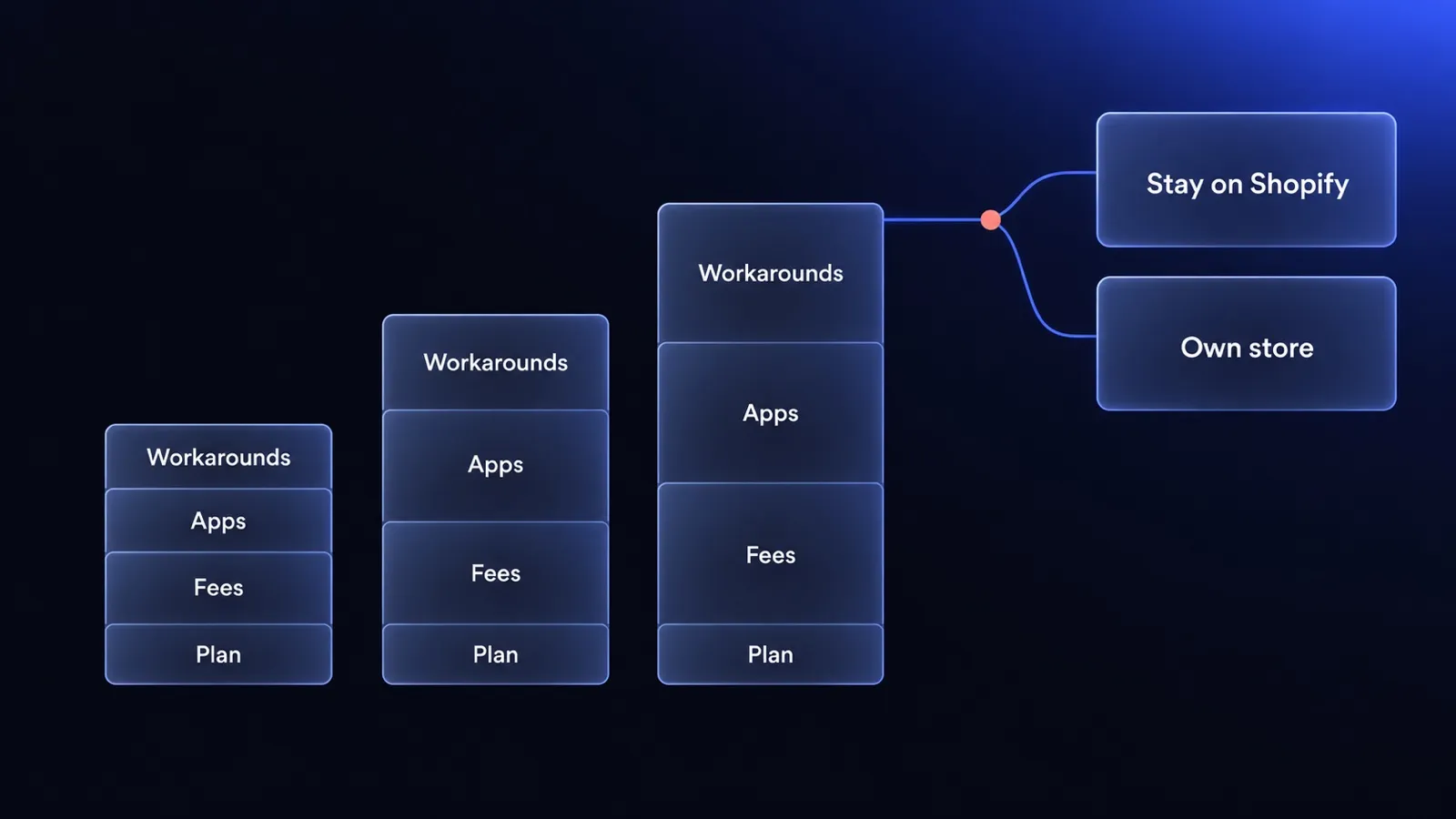
Is Shopify worth it in 2026? For most US stores, yes. See when revenue-based fees, apps and workarounds make it stop paying off, counted over 24 months.
Shopify Plus pricing in 2026: the real total cost for B2B
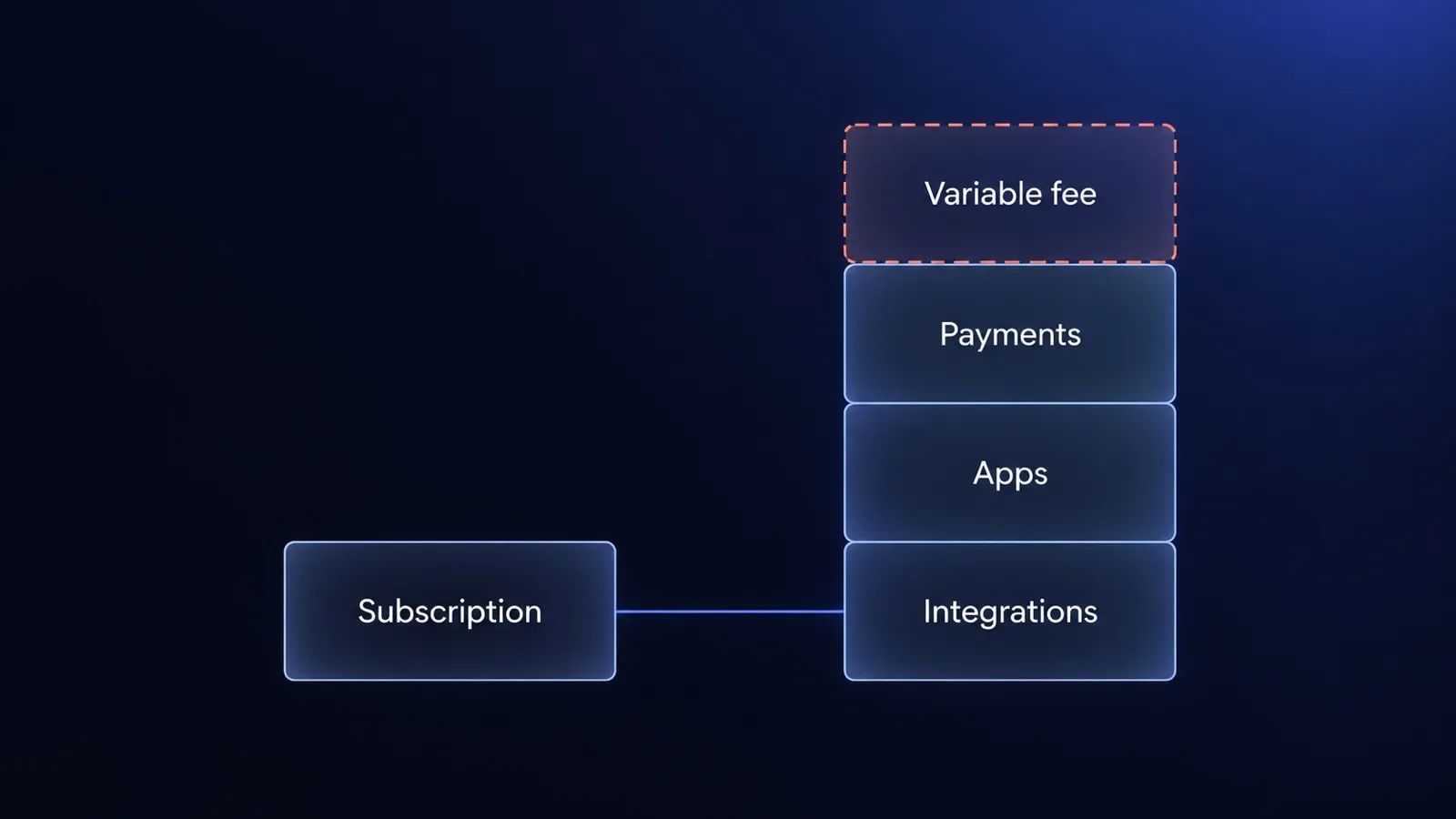
Shopify Plus pricing starts at $2,300 a month. For B2B, the real cost sits in the variable fee, payments, apps and integrations. What to count before you sign.
Custom or off-the-shelf software? Calculate the cost of the whole operating model.
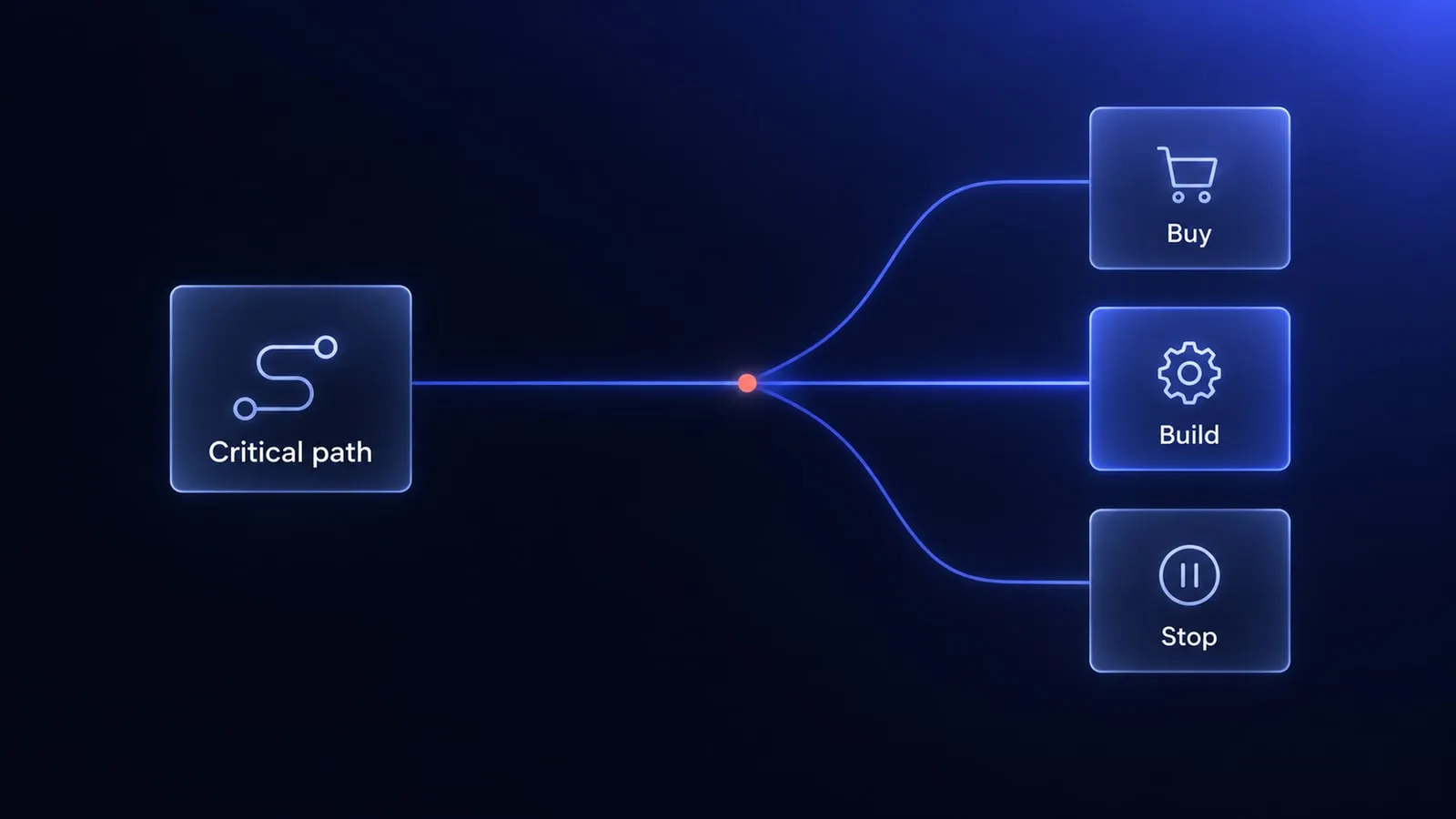
A practical custom versus off-the-shelf framework covering 24-month cost, process fit, integrations, risk and product advantage.


Questions after reading?
Tell us what the article leaves open for your company. We reply within one working day and prepare a hypothesis before any call.
A question about the article Something does not match your situation, or you want to check an assumption behind a number.
Your own problem Describe the sales process and where your current platform stops being enough.
The next step You are weighing custom, off-the-shelf or a migration and want a second opinion before you commit.