
Is Shopify worth it in 2026? When Shopify stops paying off for a growing store
Is Shopify worth it once your store grows? The plan is the smallest line on a growing store's Shopify bill. This guide shows which US costs scale with revenue, when Shopify is still the right choice and when a store you own costs less over 24 months.
Short answer
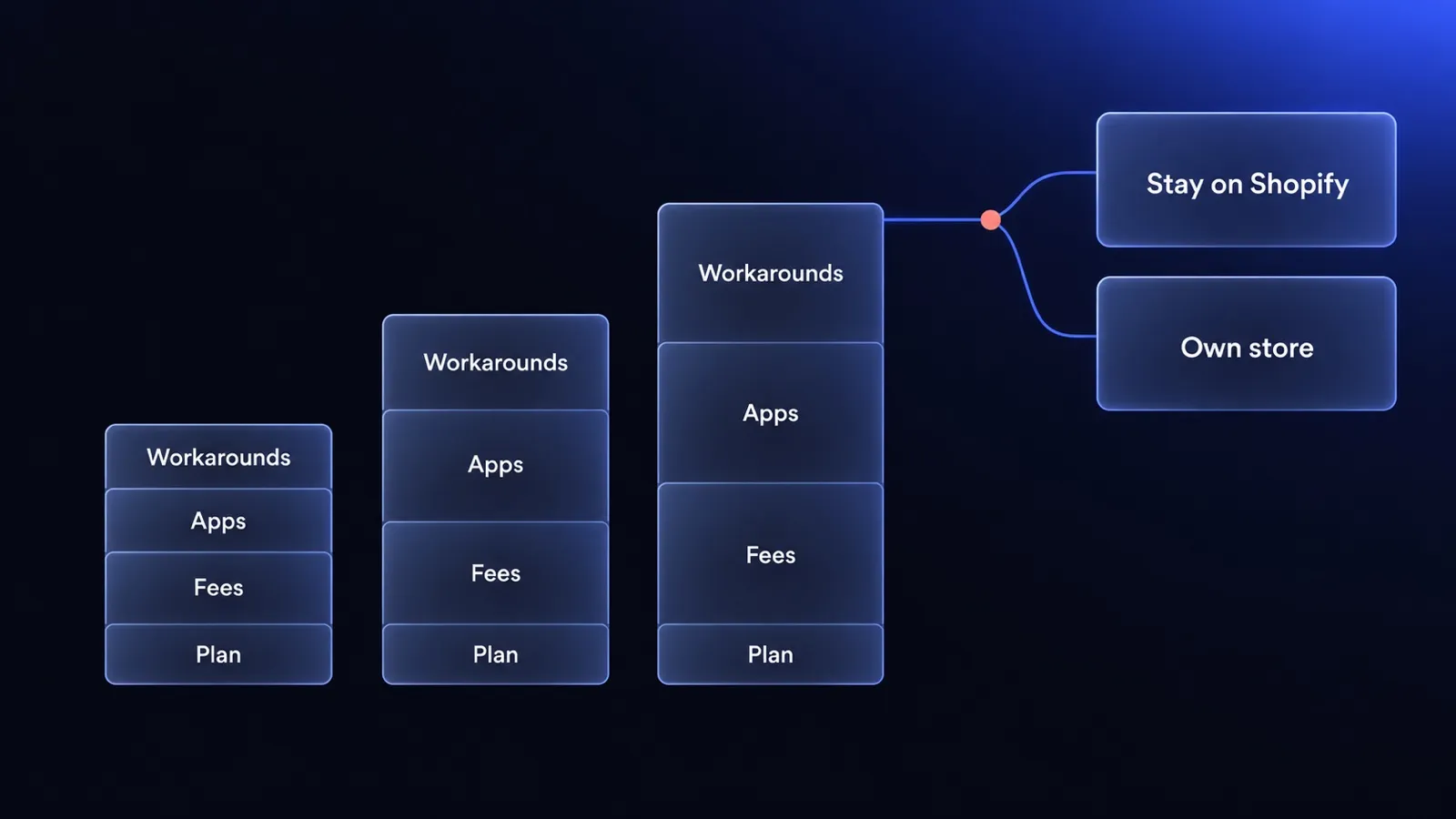
Yes, for most US stores Shopify is worth it in 2026: the Basic to Advanced plans cost $29 to $299 a month billed yearly (source, as of 2026-10), and for a standard B2C store the hosting, checkout and payments Shopify bundles are hard to beat. For a growing store, though, the subscription is the smallest line on the bill, and card fees, Shopify Tax and other fees that scale with revenue, plus the apps and workarounds a non-standard process needs, decide the total. Shopify stops paying off when those workarounds, typically for B2B price lists, ERP sync or a custom checkout, cost more over 24 months than building and running a store you own.
Is Shopify worth it? The short answer by store type
Shopify is worth it for a standard B2C store, and worth it with conditions for a growing store that sells B2B or runs its prices and stock from an ERP. The answer depends less on revenue than on how far your sales process differs from the one Shopify was built for.
| Store profile | Verdict | What to check |
|---|---|---|
| New or small B2C store | Worth it | Basic or Grow on yearly billing, a short app list |
| Growing B2C store with one price list | Worth it, watch the fees | Plan breakpoints, Shopify Tax, share of international cards |
| B2C plus B2B, ERP as the source of truth | Count before you renew | Number of B2B catalogs, ERP connector, hours of manual fixes |
| Many B2B price lists, order approvals, custom checkout | Likely stops paying off | 24-month cost of apps and workarounds against a store you own |
A large B2C brand with one price list can stay on Shopify for years without a cost problem. A much smaller wholesaler with dozens of negotiated price lists meets Shopify’s three-catalog limit below Plus on day one.
How much does Shopify cost in the US in 2026?
Shopify’s US plans cost $29, $79 and $299 a month (source, as of 2026-10) on yearly billing for Basic, Grow and Advanced, or $39, $105 and $399 (source, as of 2026-10) on monthly billing, and Shopify Plus starts at $2,300 a month (source, as of 2026-10) on a three-year term. Each plan also sets the card rate and the fee Shopify charges when you use another payment provider:
| Plan | Monthly billing or 1-year term | Yearly billing or 3-year term, per month | Online card rate, Shopify Payments | Fee for a third-party payment provider |
|---|---|---|---|---|
| Basic | $39 (source, as of 2026-10) | $29 (source, as of 2026-10) | 2.9% + 30¢ (source, as of 2026-10) | 2% (source, as of 2026-10) |
| Grow | $105 (source, as of 2026-10) | $79 (source, as of 2026-10) | 2.7% + 30¢ (source, as of 2026-10) | 1% (source, as of 2026-10) |
| Advanced | $399 (source, as of 2026-10) | $299 (source, as of 2026-10) | 2.5% + 30¢ (source, as of 2026-10) | 0.6% (source, as of 2026-10) |
| Plus | from $2,500 (source, as of 2026-10) | from $2,300 (source, as of 2026-10) | from 2.25% + 30¢ (source, as of 2026-10) | 0.2% (source, as of 2026-10) |
The card rates in the table are for standard domestic cards. Shopify’s US pricing page lists higher online rates for premium cards, 3.5%, 3.3% and 3.1% + 30¢ (source, as of 2026-10) on Basic, Grow and Advanced, and adds 1% (source, as of 2026-10) for international cards on every plan. Check the share of both card types in your payment reports before you estimate fees.
Yearly billing saves about 25% on every standard plan, by our calculation: $240 over 24 months on Basic, $624 on Grow and $2,400 on Advanced. New stores get a three-day free trial and then pay $1 a month for three months (source, as of 2026-10).
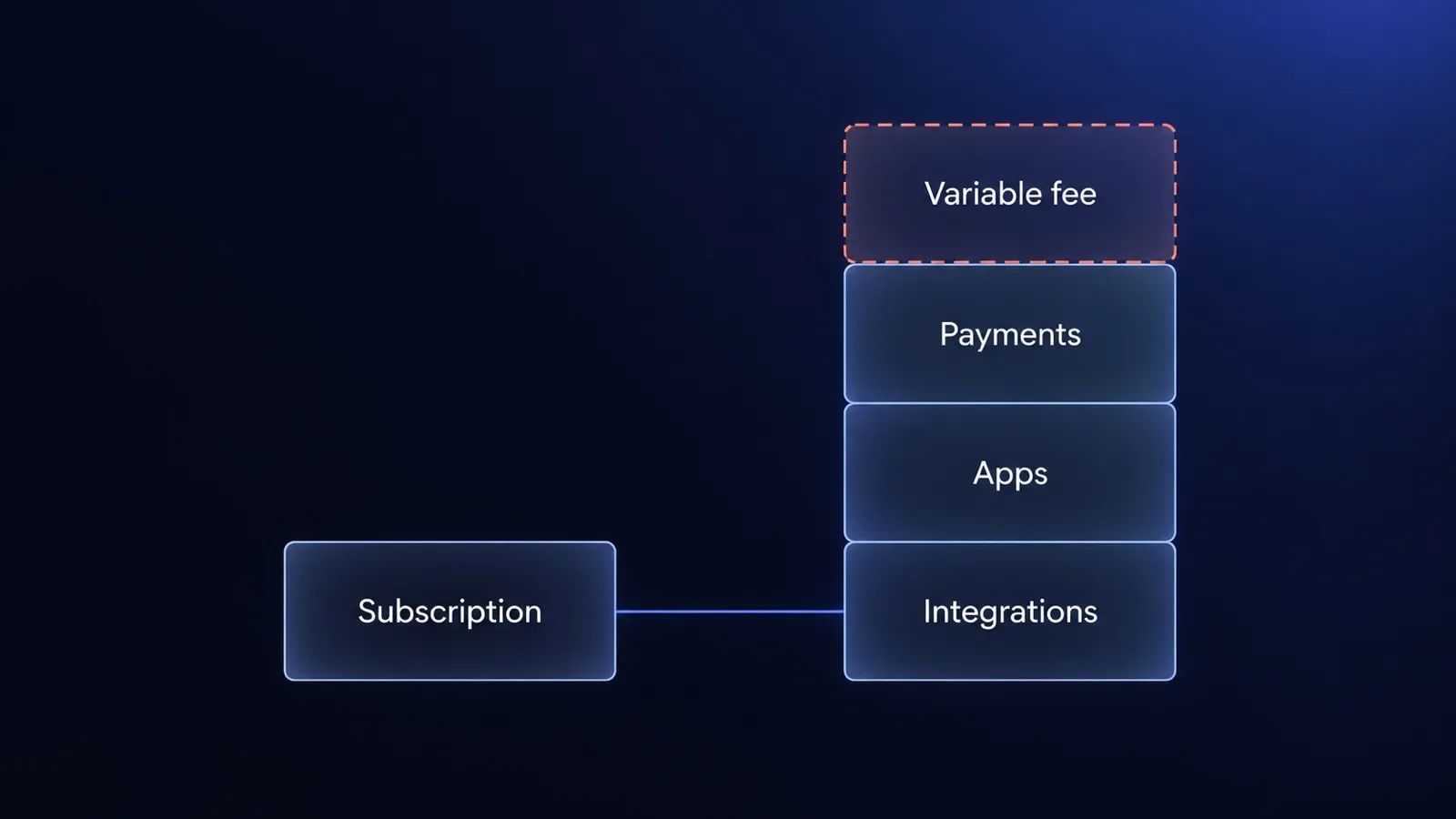
Shopify Plus has its own pricing logic, including a variable fee and B2B features reserved for Plus, which we cover in what Shopify Plus really costs a B2B company. This guide uses only the published Plus flat fee and card rate.
Why the subscription is the smallest line on your Shopify bill
For a growing store, the Shopify plan is a few percent of what the store pays Shopify, because card fees grow with every order and the plan price does not. The table below is our calculation from the rates above, assuming yearly billing (a three-year term for Plus), a $100 average order, all sales paid by domestic standard cards through Shopify Payments, and the cheapest plan at each sales level.
| Card sales a month | Cheapest plan | Plan and card fees a month | Over 24 months | Share of sales | Plan’s share of the fees |
|---|---|---|---|---|---|
| $50,000 | Grow | $1,579 | $37,896 | 3.16% | 5.0% |
| $200,000 | Advanced | $5,899 | $141,576 | 2.95% | 5.1% |
| $500,000 | Advanced | $14,299 | $343,176 | 2.86% | 2.1% |
| $1,000,000 | Plus, flat fee on a three-year term | $27,800 | $667,200 | 2.78% | 8.3% |
The $1,000,000 example on Plus uses the lowest published Plus card rate, from 2.25% + 30¢, and the $2,300 flat fee on a three-year term only. Shopify says more complex, higher-volume Plus businesses may pay a variable platform fee instead and does not publish its rate, so the real Plus figure at this volume comes only from your quote.
Shopify’s plan breakpoints show how small the plan decision is. A breakpoint is the difference in monthly plan price divided by the difference in card rate. On card fees and yearly billing, by our calculation, Grow becomes cheaper than Basic from about $25,000 of card sales a month ($50 ÷ 0.2%), Advanced cheaper than Grow from about $110,000 ($220 ÷ 0.2%), and Plus on the flat three-year fee cheaper than Advanced only from about $800,000 ($2,001 ÷ 0.25%). On monthly billing the first two breakpoints move to about $33,000 and $147,000.
With a third-party payment provider, Shopify’s plan breakpoints drop sharply, because Shopify’s third-party fee differs more between plans (2%, 1% and 0.6%) than its card rates do (2.9%, 2.7% and 2.5%). By the same calculation on yearly billing, Grow pays for itself against Basic from about $5,000 of third-party sales a month ($50 ÷ 1%), and Advanced against Grow from about $55,000 ($220 ÷ 0.4%).
Choosing the right plan saves a few tenths of a percent of sales. It is worth doing, but it does not answer whether Shopify is worth it.
Card processing costs money on any platform. A store you own still pays its payment provider a percentage and a fixed fee per order, so most of the card fee line stays after a migration. Compare the Shopify Payments rate with the rate your own provider quotes you, and count only the difference.
Which Shopify fees grow with your revenue?
Apart from card processing, four Shopify-specific fees grow with revenue: Shopify Tax, the fee for a third-party payment provider, the marketplace sync fee and, on Plus, the variable platform fee. A store you own does not pay these lines to Shopify.
Shopify Tax: 0.35% of taxed orders after $100,000 in sales
Shopify Tax charges US stores on Basic, Grow and Advanced 0.35% per order (source, as of 2026-10) once the store passes $100,000 in sales (source, as of 2026-10), capped at $0.99 per order (source, as of 2026-10). Plus stores pay 0.25% (source, as of 2026-10). The fee applies to orders from states and other regions where you have tax collection activated, including orders where no tax is charged because a product is exempt, and not to orders from regions where you do not collect tax.
For stores created on or after May 13, 2026, the $100,000 threshold is lifetime: once crossed, the Shopify Tax fee applies to every taxed order. Stores created earlier have an annual threshold and a cap of $5,000 a year per region (source, as of 2026-10).
The $0.99 cap takes over at orders of about $283, by our calculation, so a $2,000 B2B order pays $0.99 while a $100 B2C order pays $0.35. Shopify Tax is mostly a cost of B2C order volume: at $200,000 a month in $100 orders, all from regions where you collect tax, it adds up to $700 a month (2,000 orders × $0.35), or up to $16,800 over 24 months.
A store you own still has to calculate US sales tax, so put the price of the tax service you would use on the other side of the comparison.
Third-party payment providers: 2% to 0.2% on top of the provider’s fee
With a provider other than Shopify Payments, Shopify charges 2%, 1%, 0.6% or 0.2% (source, as of 2026-10) of those sales on Basic, Grow, Advanced and Plus, on top of the provider’s own fee. At $100,000 a month through a third-party provider on Grow, that is $1,000 a month, or $24,000 over 24 months, by our calculation.
Marketplace sync above 50 orders a month
Shopify charges 1%, up to $99 a month (source, as of 2026-10) once synced marketplace orders pass 50 a month. The cap keeps this fee small, at most $2,376 over 24 months, but it is one more line that rises with sales.
The Shopify Plus variable platform fee
Shopify’s Shopify Plus plan page confirms that more complex, higher-volume Plus businesses may pay a variable platform fee based on revenue and business model, but Shopify does not publish the rate, the threshold or a cap. If your volume puts you near Plus, read how the Plus variable fee works and what to ask for in your quote before you plan an upgrade.
Apps and workarounds: where a growing store’s bill really grows
The biggest difference between Shopify and a store you own is not the price list but what you pay to make Shopify fit your process. Apps, connectors, agency hours and manual work fill the gaps, and each recurs for as long as you stay.
The app stack
Apps billed by order count or revenue band behave like a revenue-based fee: they grow with the store while the plan stays the same. Shopify does not publish a typical app budget, so build your own list: for each app, the plan you need at your expected order volume, the price from its Shopify App Store listing and the date you checked it.
B2B on Shopify: three catalogs below Plus
Shopify B2B, with companies, net payment terms and self-serve ordering, runs on every plan from Basic up. Below Plus, though, a store can have up to three active B2B catalogs across all its B2B markets, according to Shopify’s B2B plan features page. Catalogs assigned directly to a company, deposits and partial payments are Plus-only.
Three catalogs cover a few price tiers, not contract prices for hundreds of accounts or quotes with approvals, which is where B2B e-commerce with your own price lists starts. Selling to both businesses and consumers? See how to run B2B and B2C in one store.
ERP sync: NetSuite, Microsoft Dynamics 365 and SAP
A US store on NetSuite, Microsoft Dynamics 365 or SAP usually connects Shopify through a paid connector or a custom integration. We found no public price lists for these connectors, so ask for a quote at your order volume, with maintenance terms.
With an ERP connector, ask who handles exceptions: a failed order sync, a customer price the connector cannot map, a credit limit the ERP owns. If the answer is a person fixing records by hand, count that time. How the ERP sync handles exceptions often decides the 24-month comparison, which is the case for ERP integration without a chain of apps.
Workarounds your team pays for
Manual work is the Shopify cost no invoice shows. Count the hours your team spends re-keying B2B orders, correcting stock or applying prices by hand, and multiply them by what an hour costs you. If two people spend five hours a week each and an hour costs $40, that is about $1,733 a month (2 × 5 hours × $40 × 52 weeks ÷ 12), or $41,600 over 24 months.
How to count 24 months of Shopify against a store you own
A fair comparison counts 24 months with the same scope on both sides. Use these steps:
- Plan fee times 24, at the plan your expected volume needs.
- Card fees at your real mix of standard, premium and international cards.
- Fees that scale with revenue: Shopify Tax, the third-party provider fee and marketplace sync.
- Apps times 24, priced at the plan your volume needs.
- Integrations: the build, the connector subscription and the hours to keep the sync running.
- Workaround hours times your hourly cost times 24.
- Growth: the lines that scale with sales, at the volume you expect in month 24.
Then put the same lines next to a store you own:
| Line | Shopify | Store you own |
|---|---|---|
| Platform fee | Plan fee every month | No licence fee for Medusa’s open-source core |
| Card processing | Shopify Payments rates | Your payment provider’s rates |
| Third-party provider fee | 2% to 0.2% of those sales | None |
| Sales tax calculation | Shopify Tax after the threshold | A tax service you choose and pay for |
| Apps | Each app’s monthly price | Fewer apps, some logic built into the store |
| Build | Theme and agency work | Build of the store, from €10,000 net with Evelumo |
| Hosting | Included in the plan | Paid separately |
| Hosting and maintenance | Agency hours | From €100 net a month with Evelumo, hosting included |
Medusa’s core is open source under the MIT licence, with no licence fee or revenue share. RBAC and SSO have been under Medusa’s paid Enterprise licence since August 2026, so check whether your project needs them.
Take this scenario: $200,000 of monthly online sales, 20% of it B2B paid by bank transfer, a $100 average order and Advanced on yearly billing. By our calculation, the $160,000 paid by card means 1,600 orders and $4,480 a month in card fees, or $107,520 over 24 months, while the plan costs $7,176. If every order comes from a region where you collect tax, Shopify Tax adds up to $16,800.
In that scenario, the plan and Shopify Tax, the two Shopify-specific fees, come to about $24,000 over 24 months ($7,176 plus up to $16,800). Most of the $107,520 in card fees would stay on a store you own, which also pays for a sales tax service, hosting and maintenance, so the fee difference alone is rarely large enough to justify a migration. The decision rests on what Shopify does not price: apps, the ERP connector, B2B price lists beyond three catalogs and hours of manual work.
The calculator below works in euros, with the prices Shopify lists for the euro area, and opens on the same scenario in euros: €200,000 of monthly online sales, 20% of it B2B paid by bank transfer, a €100 average order and Advanced on yearly billing. It has no Shopify Tax line, so add that estimate to its result. It marks every figure that is not confirmed as an assumption you can change. Enter what you pay each month for apps, agency hours and workarounds in the field under the plan, and open Adjust assumptions for your implementation quote and the build and maintenance of your own store, which open on our starting prices of €10,000 net and €100 net a month. The own store’s payment provider opens on Stripe’s published rate for standard European cards. The same method works for any platform choice when you compare off-the-shelf and custom over 24 months.
24-month cost: Shopify or your own store
Set your sales and plan to see which one costs less over 24 months (net amounts).
€289 a month
For example B2B apps, an ERP connector, agency hours.
- Shopify
- €81,816
- Own store
- €79,600Cheaper
Your own store costs €2,216 less over 24 months and pays back in month 20.
Shopify
- Plan
- €6,936
- Payment and Shopify fees
- €74,880
Own store
- Build
- €10,000
- Hosting and maintenance
- €2,400
- Payment provider
- €67,200
Adjust assumptionsOrders, B2B, payments, own store
Prices checked on October 7, 2026.Sources and dates
Verified on official pages
- Shopify Plus, 1-year contract: €2,250 (shopify.com, as of 2026-10-03)
- Shopify Plus, 3-year contract: €2,100 (shopify.com, as of 2026-10-03)
- Shopify Plus, expansion stores included: 9 (shopify.com, as of 2026-10-03)
- Shopify Plus, each extra store per month: €250 (shopify.com, as of 2026-10-03)
- Plus, Shopify fee for a third-party provider: 0.2% (shopify.com, as of 2026-10-03)
- Stripe, standard EEA cards: 1.5% (stripe.com, as of 2026-10-07)
- Stripe, fee per card charge: €0.25 (stripe.com, as of 2026-10-07)
- Stripe, premium EEA cards: 2.8% (stripe.com, as of 2026-10-07)
- Stripe, international cards: 3.15% (stripe.com, as of 2026-10-07)
- Evelumo, live e-commerce in 30 days, starting price (net): €10,000 (evelumo.com, as of 2026-10-03)
- Evelumo, own-store maintenance, starting rate per month (net): €100 (oferta Evelumo, 2026-10, as of 2026-10-07)
Assumptions: not published by Shopify, or not yet confirmed for this market
- Basic, monthly billing: €32 (shopify.com/at, as of 2026-10-03)
- Basic, yearly billing, per month: €24 (shopify.com/at, as of 2026-10-03)
- Grow, monthly billing: €92 (shopify.com/at, as of 2026-10-03)
- Grow, yearly billing, per month: €69 (shopify.com/at, as of 2026-10-03)
- Advanced, monthly billing: €384 (shopify.com/at, as of 2026-10-03)
- Advanced, yearly billing, per month: €289 (shopify.com/at, as of 2026-10-03)
- Basic, card rate: 2% (shopify.com/at, as of 2026-10-03)
- Basic, card fee per order: €0.25 (shopify.com/at, as of 2026-10-03)
- Grow, card rate: 1.9% (shopify.com/at, as of 2026-10-03)
- Grow, card fee per order: €0.25 (shopify.com/at, as of 2026-10-03)
- Advanced, card rate: 1.7% (shopify.com/at, as of 2026-10-03)
- Advanced, card fee per order: €0.25 (shopify.com/at, as of 2026-10-03)
- Plus, card rate: 1.5% (shopify.com/at, as of 2026-10-03)
- Plus, card fee per order: €0.25 (shopify.com/at, as of 2026-10-03)
- Basic, Shopify fee for a third-party provider: 2% (shopify.com/at, as of 2026-10-03)
- Grow, Shopify fee for a third-party provider: 1% (shopify.com/at, as of 2026-10-03)
- Advanced, Shopify fee for a third-party provider: 0.6% (shopify.com/at, as of 2026-10-03)
- Shopify Plus variable fee, D2C: 0.25% (taylorsicard.com, as of 2026-10-03)
- Shopify Plus variable fee, B2B: 0.18% (atwix.com, as of 2026-10-03)
All amounts are net of VAT and shown without exchange rates. Card rates are Shopify's standard online card rates. Other payment methods can cost more. Your own store's payment provider defaults to Stripe's published rate for standard EEA cards. The variable fee model is the partners' description, not Shopify's. Its B2B rate is applied here instead of the D2C rate. How VAT applies to Shopify's invoices is not confirmed.
When Shopify is still worth it
Shopify is still worth it when your process fits Shopify’s standard model and the fees that scale with revenue stay small in absolute numbers. A store you own would then add a build, hosting and maintenance without removing the costs that matter.
Stay on Shopify when:
- you sell mostly B2C with one price list, through Shopify Payments
- your B2B price lists fit in three catalogs and you do not need deposits or partial payments
- your few integrations run without weekly manual fixes
- you have no in-house IT and do not want to own a platform
- Shopify Tax, the third-party fee and app costs add up to less than a build over 24 months
If you stay, change the plan at the right breakpoint, move to Shopify Payments if the third-party fee is large, and cut overlapping apps. Sometimes the whole project is to simplify an app-heavy store before you migrate.
When Shopify stops paying off for a growing store
Shopify stops paying off for a growing store when the cost of fitting the process to Shopify grows faster than the store’s margin. The signals show up in operations before the budget:
- Many B2B price lists: contract prices per account, quotes and order approvals that do not map to three catalogs.
- The ERP is the source of truth: prices, stock and credit limits live in NetSuite, Dynamics 365 or SAP, and the connector cannot express the rules.
- Apps grow faster than margin: several apps billed by volume patch one process.
- Checkout logic of your own: pricing, payment or delivery rules that the standard checkout does not support.
- Plus for one feature: a Plus contract signed for a single capability, such as more catalogs.
When these signals appear, moving to another hosted platform with similar standard limits rarely solves the problem. The Shopify alternative that does is a store whose logic you own, for example on Medusa, modelling price lists, approvals and ERP data the way your sales team works. Alufix, a complete e-commerce build on Medusa.js, is one our team built.
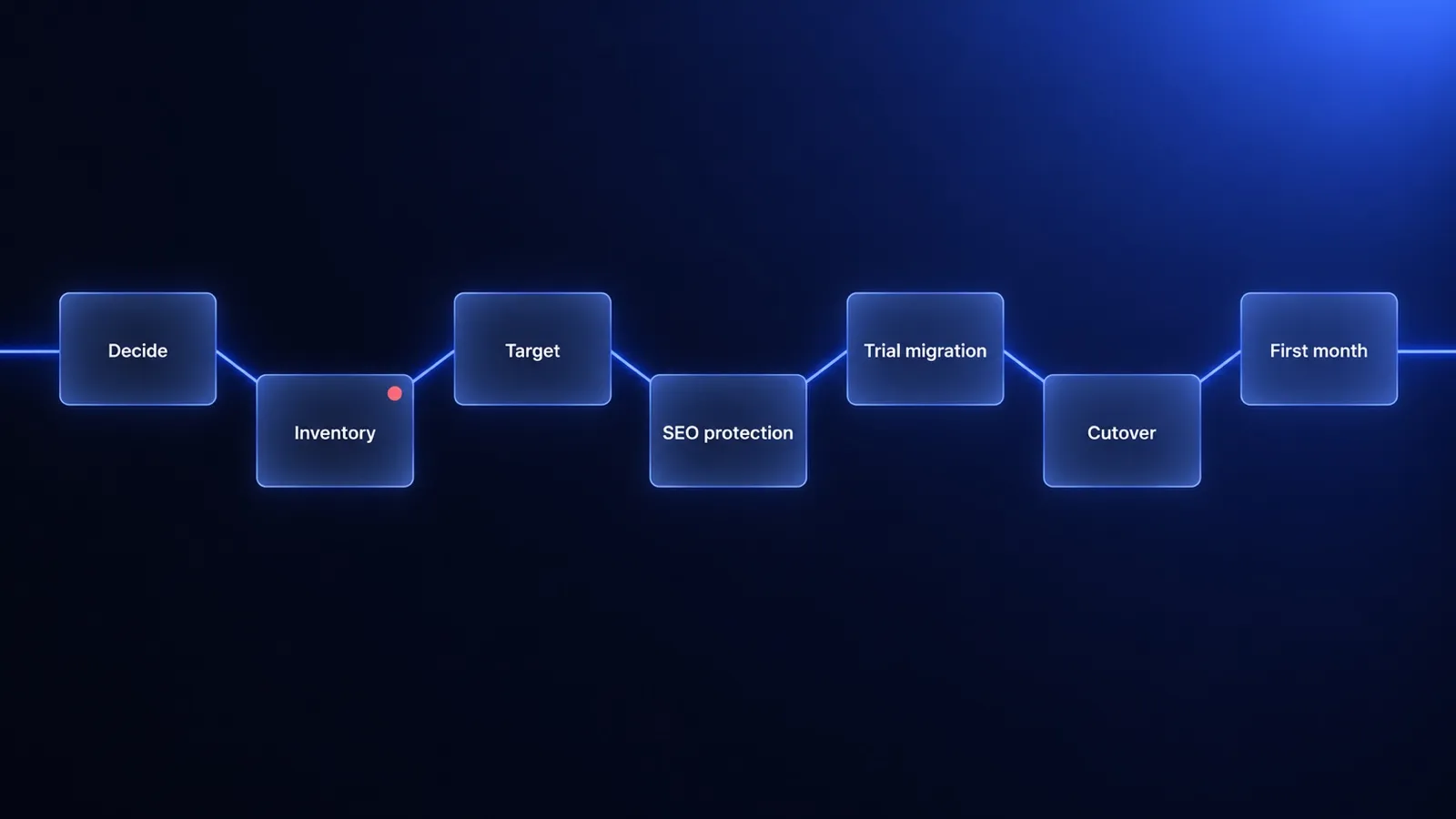
A move off Shopify is a project in its own right, with data, SEO redirects and integrations to carry over. If your 24-month count points that way, plan a move off Shopify without losing traffic. Our live e-commerce in 30 days offer starts from €10,000 net for a B2B and B2C store on our Medusa foundation; that is where a build starts, not a match for any one Shopify bill.
Frequently asked questions
Is Shopify worth it for a small business?
Usually yes. A small US business selling to consumers gets hosting, a tested checkout, security updates and card processing in one subscription, starting at $29 a month on yearly billing. Building and running your own store rarely costs less at that size. The calculation changes when you sell to businesses with negotiated prices, connect an ERP or add several paid apps to cover one process.
How much does Shopify take per sale?
With Shopify Payments, a standard online card payment in the US costs 2.9%, 2.7% or 2.5% plus 30 cents on Basic, Grow and Advanced. If you use another payment provider, Shopify charges an extra 2%, 1% or 0.6% of the sales that go through it, and the provider bills its own fee separately. Shopify Tax adds 0.35% of taxed orders after your first $100,000 in sales, capped at $0.99 per order.
What are the hidden costs of Shopify?
The costs most often missing from a first budget are apps billed by order volume, Shopify Tax, higher rates for premium and international cards, ERP connectors, agency hours for theme and checkout changes, and the staff time spent fixing orders by hand. None of them appears in the plan price, and most of them grow as the store grows, so count them over 24 months.
When should you leave Shopify?
Consider leaving when the apps, connectors and manual work you pay for to fit B2B pricing, ERP rules or a custom checkout cost more over 24 months than building and maintaining your own store with the same scope. A standard B2C store that uses Shopify Payments and a short app list rarely reaches that point, so for many stores the right answer is to stay.
Is Shopify Plus worth it?
On card rates alone, Plus pays for itself only at very high volume, roughly $800,000 a month in card sales, comparing Plus on a three-year term with Advanced on yearly billing, by our calculation. Below that, Plus is a decision about features, such as unlimited B2B catalogs or deposits. Shopify also does not publish its variable platform fee, so get a written quote before deciding.
Keep reading
Shopify Plus pricing in 2026: the real total cost for B2B
Shopify Plus pricing starts at $2,300 a month. For B2B, the real cost sits in the variable fee, payments, apps and integrations. What to count before you sign.

Custom or off-the-shelf software? Calculate the cost of the whole operating model.
A practical custom versus off-the-shelf framework covering 24-month cost, process fit, integrations, risk and product advantage.
Ecommerce platform migration: a step-by-step checklist for B2B companies
Ecommerce platform migration in seven gates: what to inventory before you choose a target, how to protect SEO with a redirect map, and when to stay put.


Questions after reading?
Tell us what the article leaves open for your company. We reply within one working day and prepare a hypothesis before any call.
A question about the article Something does not match your situation, or you want to check an assumption behind a number.
Your own problem Describe the sales process and where your current platform stops being enough.
The next step You are weighing custom, off-the-shelf or a migration and want a second opinion before you commit.