
Shopify Plus pricing in 2026: the real total cost for B2B
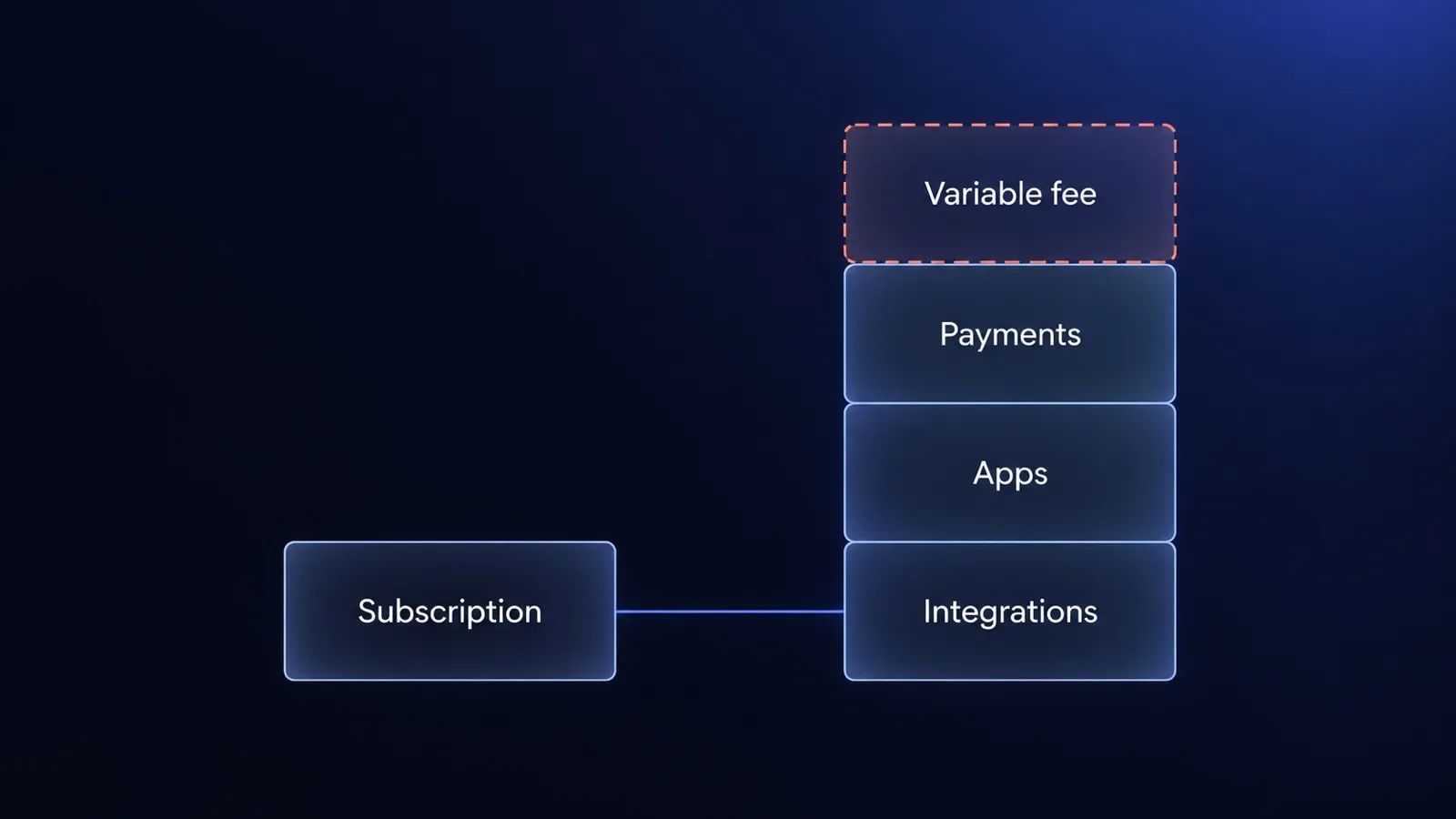
The subscription is the smallest and most predictable line. This guide lists every cost a B2B company pays on Shopify Plus over 24 months, which numbers Shopify does not publish, and when you do not need Plus at all.
Short answer
Shopify Plus pricing starts at $2,300 a month (source, as of 2026-10) on a three-year term or $2,500 a month (source, as of 2026-10) on a one-year term, but for a B2B company the subscription is the smallest and most predictable line. The real total cost depends on a variable platform fee that Shopify does not publish, payment fees on large orders, apps that fill B2B gaps and agency work on checkout and ERP integration. B2B features run on every Shopify plan from Basic up, so check first whether you need Plus at all, then compare 24 months of Plus with a store you own.
How much does Shopify Plus cost in 2026?
Shopify Plus has a flat platform fee of $2,300 a month (source, as of 2026-10) on a three-year term and $2,500 a month (source, as of 2026-10) on a one-year term, according to Shopify’s help center. Shopify publishes the same fee in euros and pounds:
| Currency | 1-year term, per month | 3-year term, per month |
|---|---|---|
| USD | $2,500 (source, as of 2026-10) | $2,300 (source, as of 2026-10) |
| EUR | €2,250 (source, as of 2026-10) | €2,100 (source, as of 2026-10) |
| GBP | £1,950 (source, as of 2026-10) | £1,800 (source, as of 2026-10) |
The three-year term costs $200 a month less than the one-year term in US dollars. Over 24 months that difference is $4,800, paid for with a contract that runs a year longer than the period you are pricing.
The flat fee covers your main store and nine expansion stores. Shopify’s EU pricing page lists each additional store at €250 a month (source, as of 2026-10). We could confirm only the euro amount, so ask for the price in your own currency if you plan more than ten stores.
Agency articles in the top search results quote the same figures, which match Shopify’s help center. Together with the third-party gateway fee, they are the only Shopify Plus costs that Shopify publishes in full.
What does the Shopify Plus subscription include?
The Shopify Plus platform fee pays for the platform and the features reserved for the Plus plan. For a B2B company, the included items that matter most are:
- Expansion stores: the main store plus nine more, which Shopify describes as intended for international markets, separate physical locations and similar purposes.
- Unlimited staff accounts: adding people to the admin does not raise the fee.
- B2B features reserved for Plus: unlimited B2B catalogs, catalogs assigned directly to a company, and deposits or partial payments.
The platform fee does not cover the lines that usually decide the total cost:
- The variable platform fee, if your quote uses one (next section).
- Payment processing, through Shopify Payments or a third-party provider.
- Apps for quotes, pricing rules, search, product data and ERP connections.
- The theme and storefront work that turns a standard theme into a B2B ordering experience.
- Implementation, migration and ERP integration, usually done by an agency.
- Maintenance and change requests after launch.
The variable platform fee: the number Shopify does not publish
Shopify’s help center says that more complex, higher-volume businesses may pay a variable platform fee based on revenue and business model, and that this fee differs for B2B and D2C companies, but Shopify publishes no rate, no threshold and no cap. The Shopify Plus plan page confirms the fee exists and stops there.
The variable fee is the reason two Shopify Plus quotes with the same flat fee can lead to very different bills. Revenue, the split between B2B and D2C, and the contract term all change the result, and none of them appears in a public price list.
Which sales count toward the platform fee
Shopify’s Plus pricing definitions count online and point-of-sale transactions, from both consumers and business buyers, as eligible platform transactions. The only exclusion is imported orders, meaning orders processed and paid on another platform or another Shopify store and later imported. The definitions page we read is the New Zealand version dated February 2024, so confirm the same wording in your own agreement.
For a wholesaler, Shopify’s platform transaction definition means the whole B2B volume processed through Shopify sits in the base of a revenue-based fee. Moving existing wholesale orders from email, phone or an old portal onto Shopify Plus adds that volume to the base.
Orders paid manually, for example by bank transfer, are excluded from the gateway fee described in the payments section, but the platform transaction definition contains no such exclusion. As the definitions read, a B2B order paid by bank transfer on net terms still counts toward the platform fee. Ask Shopify to confirm this in writing.
What partners report
Shopify partners and consultancies publish estimates of the variable fee. The estimates agree on some points and disagree on others, and none of them links to a Shopify price list.
| Source | Variable fee estimate | Threshold and cap |
|---|---|---|
| atwix.com, B2B guide, updated October 2026 | 0.25% to 0.4% of monthly revenue, plus 0.18% on the wholesale channel (source, as of 2026-10) | from about $800,000 a month, capped at $40,000 a month (source, as of 2026-10) |
| taylorsicard.com, Plus cost calculator, reviewed October 2026 | 0.25% to 0.40% (source, as of 2026-10) | from about $800,000 a month, reportedly capped at $40,000 a month (source, as of 2026-10) |
| brokenrubik.com, NetSuite consultancy, updated July 2026 | 0.25% of monthly GMV (source, as of 2026-10) | Above unspecified GMV thresholds |
What to ask for in your quote
The variable fee becomes a known number only in your own quote. Ask Shopify for these points in writing before you sign:
- The variable fee rate for each channel: online D2C, B2B and point of sale.
- The monthly sales threshold at which the variable fee replaces the flat fee.
- Any monthly cap on the variable fee.
- Whether the rate depends on a one-year or a three-year term.
- What happens when you cross the threshold during the contract: when the new fee starts and whether it can return to the flat fee.
- Whether B2B orders paid by bank transfer or on net terms count toward the platform fee in your agreement.
- Your Shopify Payments card rates for each country you sell in.
- The price of each expansion store beyond the nine included, in your currency.
Payment and transaction fees on B2B orders
On Shopify Plus, card payments through Shopify Payments carry Shopify’s card processing fees and no separate transaction fee, while orders paid through a third-party payment provider carry the provider’s fee plus 0.20% per transaction (source, as of 2026-10) paid to Shopify. Shopify does not publish one card rate for Plus. Its pricing page says card rates vary by country, so get your rates in writing for every market you sell in.
Manual payment methods change the picture for B2B. Shopify’s pricing definitions exclude transactions through manual gateways, such as bank transfers and cash on delivery, from eligible gateway transactions. A wholesale order paid by bank transfer on net terms therefore carries no card fee and no Shopify gateway fee, although, as the definitions read, it still counts toward the platform fee.
Large B2B orders make percentage fees visible. A percentage fee on a $20,000 order is charged on the full $20,000, so the payment method for wholesale orders is a cost decision, not only a convenience for the buyer.
A worked example, using only Shopify’s published gateway fee: if B2B orders worth $150,000 a month go through a third-party payment provider, the Shopify fee on them is 0.20% (source, as of 2026-10) of $150,000. That is $300 a month, or $7,200 over 24 months, before the provider’s own fee. If the same orders are paid by bank transfer, the gateway fee on them is zero.
Apps, themes and agency work: the lines that grow fastest
Apps, theme work and agency hours are the Shopify Plus costs that grow fastest after launch, because every gap between Shopify’s B2B model and your process is usually filled by one of them.
The B2B app stack
The apps a B2B store adds on Shopify fall into five categories:
- ERP connector: syncs orders, stock, prices and customer accounts with the ERP.
- Quotes and requests for quote: lets buyers ask for a price before ordering.
- Product information management (PIM): keeps large catalogs and technical attributes consistent.
- Search: handles part numbers, synonyms and filters that standard search does not cover.
- Advanced pricing rules: volume tiers, contract prices and rules that go beyond catalogs.
Price each app from its listing in the Shopify App Store, and price the plan that fits your order volume and catalog size, not the entry plan. Write the date next to each price, because app pricing changes without notice.
For a rough benchmark, brokenrubik.com, a NetSuite consultancy, estimates that a Shopify Plus store can spend $1,000 to $3,000+ a month on apps (source, as of 2026-10). That is one firm’s estimate, not a Shopify figure. If your app list is already long, cutting the app stack can be cheaper than adding another tool.
Theme work is a separate line. Shopify offers Trade, a free theme it designed for wholesale, and includes quick order lists on every plan (B2B plan features), but a B2B storefront often needs account pages, reorder flows and product pages that match how its buyers work. That design and front-end work is agency time, paid at launch and again with every change.
Implementation and integration
Shopify does not price implementation, so the only figures available come from agencies. shopexperts.com publishes these estimates, dated June 2026 and without external sources:
| Engagement | Estimate by shopexperts.com |
|---|---|
| B2B implementation on Plus | $15,000 to $100,000+ (source, as of 2026-10) |
| ERP or PIM integration | $35,000 to $300,000+ (source, as of 2026-10) |
| Enterprise migration to Plus | $50,000 to $500,000+ (source, as of 2026-10) |
If shopexperts.com’s estimates are close to your quotes, the lower end of ERP or PIM integration alone exceeds a year of the flat platform fee on a three-year term, which is $27,600. That makes ERP integration the line to scope most carefully, including who maintains the sync after launch and who fixes it when a record fails.
Do you need Shopify Plus for B2B at all?
You do not always need Shopify Plus for B2B, because Shopify B2B runs on the Basic, Grow, Advanced and Plus plans and the core features are on every plan. Shopify’s B2B plan features page lists the differences:
| B2B feature | Basic, Grow, Advanced | Plus |
|---|---|---|
| Companies and company locations | Yes | Yes |
| Net payment terms and payment reminders | Yes | Yes |
| Draft order to invoice, PO numbers, quick order lists | Yes | Yes |
| B2B catalogs | Up to 3 active catalogs across all B2B markets | Unlimited |
| Catalogs assigned directly to a company | No | Yes |
| Deposits, partial payments, payment requests per fulfillment | No | Yes |
| Contextual checkout and storefront through Shopify Markets | Advanced only | Yes |
| Shopify Flow with B2B objects | Yes | Yes |
If your price lists fit into three catalogs and you do not need deposits or partial payments, compare Advanced with Plus before you sign. Check the Advanced price for your country on Shopify’s pricing page, and include the gateway fee: Shopify’s Polish pricing page lists 0.6% (source, as of 2026-10) on Advanced for third-party payment providers, against 0.20% (source, as of 2026-10) on Plus. The US page may list a different third-party rate for Advanced, so confirm it for your market.
The three-catalog limit is the one to test against your price lists. If every key account has its own negotiated price list, three catalogs will not be enough, and the choice becomes Plus or a platform that models customer-specific pricing directly, which is the problem B2B ecommerce development addresses.
A 24-month total cost model for a B2B company
The 24-month total cost of Shopify Plus is the sum of seven lines, and only the first is fully published by Shopify:
- Platform fee times 24, or the variable fee on all eligible sales if your quote uses it.
- Payment fees: card rates on card-paid orders, or the provider’s fee plus Shopify’s gateway fee on third-party orders.
- Extra stores beyond the nine included, times their monthly price, times 24.
- Apps times 24, priced at the plan your volume needs.
- Implementation and migration, paid once.
- Integrations: the build, plus the monthly connector cost and the hours to keep the sync running.
- Maintenance and agency hours times 24.
Here is the model with explicit assumptions: $300,000 of monthly online sales, half of it B2B, a three-year term, B2B orders paid by bank transfer and D2C orders paid through a third-party provider.
| Line | 24 months | Status |
|---|---|---|
| Platform fee, three-year term | $55,200 ($2,300 (source, as of 2026-10) × 24) | Published by Shopify |
| Shopify gateway fee on $150,000 of D2C sales a month | $7,200 (0.20% (source, as of 2026-10) × $150,000 × 24) | Published by Shopify |
| Payment provider’s own fee | From your provider contract | Not a Shopify fee |
| Variable platform fee | From your Shopify quote | Not published |
| Apps | From App Store listings | Varies by app and plan |
| Implementation and ERP integration | From agency quotes | Varies by scope |
| Maintenance | From your retainer | Varies by scope |
The two published lines add up to $62,400 over 24 months. If your quote replaces the flat fee with a revenue-based fee, calculate it on all eligible sales: at $300,000 a month, each 0.1 percentage point equals $300 a month, or $7,200 over 24 months.
The same approach works for any platform decision: compare 24 months of operation, not the starting price. The calculator below starts from the same sales scenario. It uses Shopify Payments by default, so switch the payment method to see the third-party case, and enter your own quotes for every line Shopify does not publish. Figures that come from partners rather than Shopify, such as US card rates and the variable fee estimates, are marked as assumptions you can overwrite.
24-month cost: Shopify Plus or your own store
Shopify prices are prefilled with their source. Anything Shopify does not publish is marked as an assumption you can change. Prefilled with an example scenario. Replace it with your own numbers.
- Shopify
- $140,520
- Own store
- $0
From the values entered so far, Shopify costs $140,520 over 24 months. Enter the build, hosting and maintenance from your quote to compare it with your own store. Shopify costs equal 1.95% of your online sales.
Not entered yet: apps, Shopify maintenance, Shopify implementation, payment provider fee, own store hosting, own store apps and integrations, own store maintenance, own store build.
| Cost line | Shopify | Own store |
|---|---|---|
| Subscription or hosting | $55,200 | $0 |
| Payment fees | $85,320 | $0 |
| Shopify third-party fee | $0 | $0 |
| Apps | $0 | $0 |
| Implementation and integrations | $0 | $0 |
| Maintenance | $0 | $0 |
| Total | $140,520 | $0 |
When Shopify Plus is the right choice
Shopify Plus is the right choice when your B2B and B2C process fits Shopify’s model and you would rather pay a platform fee than maintain a platform. In that case the fee buys hosting, security updates, checkout and a large app ecosystem without your own engineering team.
Plus usually fits when:
- your B2B process is covered by companies, catalogs, net terms and deposits as Shopify defines them
- you need several stores or markets, and the nine expansion stores cover them
- your team has no in-house IT and does not want one
- a fast start on an existing ecosystem matters more than control over every rule
If you sell to both businesses and consumers, also read how running B2B and B2C in one store works before you decide how many stores you need.
When Shopify Plus is the wrong choice
Shopify Plus is the wrong choice when your B2B process needs workarounds to fit the platform, or when growing B2B volume raises a revenue-based fee without adding anything you use. Each workaround becomes an app subscription or agency hours, and both recur for as long as you stay.
Typical workarounds in B2B are:
- customer-specific prices that do not map to catalogs, such as contract prices per SKU for hundreds of accounts
- multi-step order approvals inside the buyer’s company
- product configurators where price depends on options and dimensions
- an ERP that owns prices, stock and credit limits and needs a sync built around its rules
In these cases, compare Plus with a store you own, built on open-source software such as Medusa, which has no revenue-based platform fee. A store you own still has costs: the build, hosting, the payment provider’s fee, integrations and maintenance. Our maintenance for a store we built starts from 400 PLN net a month, with hosting and integrations on top. Alufix is a complete e-commerce solution our team built on Medusa.js, if you want to see what that looks like in practice.
If your 24-month comparison points away from Shopify, moving off Shopify Plus is a project in its own right, covering data, SEO redirects and integrations. If it points to your own store, we build a live store in 30 days on our Medusa foundation, B2B and B2C, from €10,000 net. The €10,000 starting price is the start of a build, not a like-for-like replacement for a year of Plus fees, so compare both options over 24 months with the same scope.
Frequently asked questions
How much does Shopify Plus cost per month in 2026?
Shopify's help center lists the Plus platform fee at $2,300 a month on a three-year term and $2,500 a month on a one-year term. More complex, higher-volume businesses can move to a variable platform fee based on revenue and business model, which Shopify says differs for B2B and D2C companies. Payment fees, apps, themes and agency work come on top.
Do you need Shopify Plus for B2B?
Not always. Shopify B2B runs on the Basic, Grow, Advanced and Plus plans, and most features, including companies, catalogs, net payment terms and self-serve ordering, are on every plan. Plus adds unlimited B2B catalogs (other plans allow three active catalogs), catalogs assigned to specific companies, and deposits or partial payments. If your price lists fit in three catalogs, compare Advanced first.
What transaction fees does Shopify Plus charge?
With Shopify Payments you pay Shopify's card processing fees and no separate transaction fee. With a third-party payment provider, Shopify adds 0.20% per transaction on Plus on top of the provider's own fees. Shopify says Plus card rates vary by country, so ask for your rate in writing before you sign.
What is the Shopify Plus variable platform fee?
It is a revenue-based platform fee that can replace the flat monthly fee for more complex or higher-volume businesses. Shopify confirms it exists and that it differs for B2B and D2C, but it does not publish the rates or the threshold. Online, POS and B2B sales count toward it. Ask for the rate per channel, the threshold and any monthly cap in your quote.
Is Shopify Plus cheaper than building your own store?
It depends on your sales volume and how far your B2B process differs from Shopify's model. Plus fees can grow with revenue, and every workaround adds apps or agency work. A store you own has a higher upfront cost and no revenue-based platform fee, but you pay for hosting and maintenance. Compare both over 24 months with the same scope.
Keep reading
Custom or off-the-shelf software? Calculate the cost of the whole operating model.
A practical custom versus off-the-shelf framework covering 24-month cost, process fit, integrations, risk and product advantage.

Medusa gives you a product reviews skeleton. We built what a real store needs on top.
Medusa has no product reviews out of the box. See the module we built: verified purchase, review request emails, moderation, Google ratings and EU rules.


Questions after reading?
Tell us what the article leaves open for your company. We reply within one working day and prepare a hypothesis before any call.
A question about the article Something does not match your situation, or you want to check an assumption behind a number.
Your own problem Describe the sales process and where your current platform stops being enough.
The next step You are weighing custom, off-the-shelf or a migration and want a second opinion before you commit.