
Medusa.js development for teams that outgrew their platform
Medusa.js is an open source e-commerce platform that can be shaped around almost any sales process. We design and build B2C stores, B2B platforms and multi-channel solutions on it. We contribute directly to Medusa, so we know it from the inside.
We contribute to Medusa and show a working store built on it.
When Medusa makes sense
Your own sales rules
Prices, discounts, buyer roles or the order flow do not fit the settings of an off-the-shelf platform.
Integrations at the core
The store has to work with ERP, PIM, WMS or partner systems, not just email orders to your team.
More apps instead of solutions
Every change needs another paid app, and the apps start to get in each other’s way.
Several channels, markets or stores
B2B and B2C, several brands or countries that should share one catalogue and one set of logic.
What you get
Architecture that fits your process
We separate what Medusa provides, what comes from our reusable implementation base and what has to be written for your business. You do not pay to rebuild things that already exist.
A storefront designed for buying
We design the storefront, usually in Next.js, around the buyer’s path: from categories and search to cart and checkout.
Your own sales logic
We extend Medusa modules and workflows with the pricing, order, role and availability rules your company needs.
Integrations with your systems
We connect payments, shipping, ERP, PIM and other systems so data flows automatically.
An admin your team can use
We extend the Medusa admin with the views and actions your team actually needs day to day.
Launch and growth
Production deployment, monitoring, documentation and full access to the code. After launch, we keep developing the store in stages.
How we work
Conversation
20 minutes with the founders: how you sell, what you want to change and whether Medusa fits the project.
Scope and fixed price
When the project is clear, we quote the first stage at a fixed price. When there are unknowns, we start with the implementation plan.
Working increments
We show each stage on your own sales scenarios, not only at acceptance.
Release
We test the critical paths, move the data and launch the store following a cutover plan.
Growth
After launch, we develop the store in further stages, each with an agreed scope and price.
Technology
Medusa is our specialisation. We choose the rest of the stack to fit the project, its integrations and your plans.
- Medusa
- Next.js
- Node.js
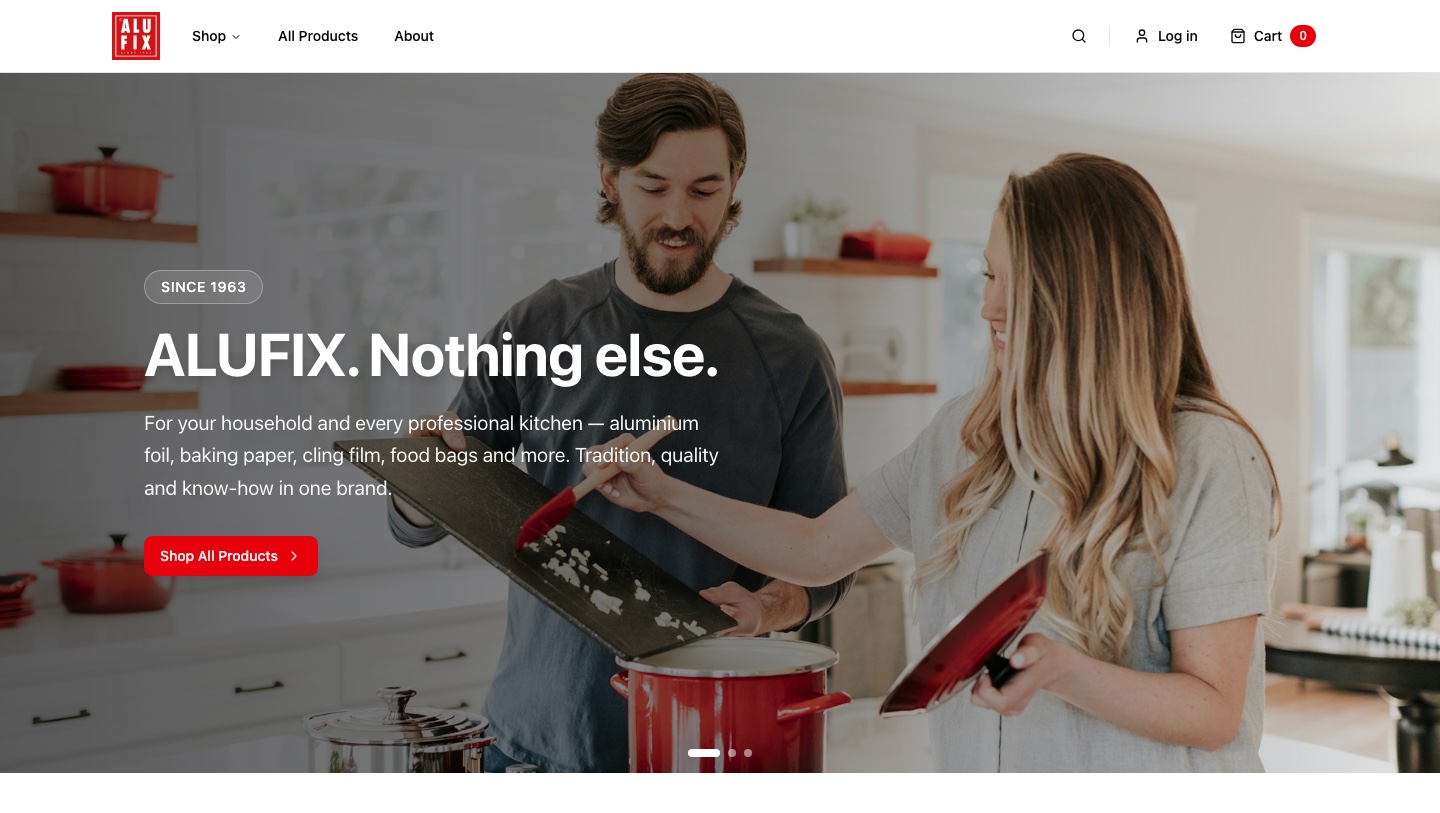
Alufix: a complete purchase journey on Medusa.js
A B2C store built end to end on Medusa.js: catalogue, search, cart and the step into checkout. You can open the store and check the journey yourself.
Read the case studyEngagement model: fixed price
We work at a fixed price for an agreed scope. Before we start, you know what each stage delivers and what it costs.
The price mainly depends on the number and complexity of integrations, the data migration scope, custom sales logic and the interface design scope.
When the scope is still unclear, we start with the implementation plan: 5 working days, €2,500 net, credited against an implementation worth more than €15,000 net.
See the implementation planQuestions about Medusa.js
What is Medusa.js?
It is an open source e-commerce platform written in Node.js and TypeScript. It provides ready commerce modules (products, cart, orders, payments, customers, pricing) that can be extended and combined with your own logic. The storefront is built separately, so it can follow any purchase journey.
Is Medusa free?
The platform itself is open source under the MIT licence, so there is no licence fee or revenue share. The costs are implementation, hosting and development. That is why we compare it with SaaS over the full period of ownership, not just the subscription price.
Medusa or Shopify?
Shopify is a good choice for standard B2C sales when its settings and apps are enough. Medusa wins when you need your own pricing, order or integration logic, full control over data and code, or one foundation for several channels.
Is Medusa suitable for B2B?
Yes. Medusa supports customer groups and price lists, and its modules can be extended with company accounts, spending limits, order approvals and quote requests. We describe the details on the B2B page.
Where does a Medusa store run?
On your own cloud infrastructure or on the managed Medusa Cloud hosting. The choice depends on your data requirements, costs and team. We settle it while defining the scope.
How much does a Medusa implementation cost?
It depends on the scope, so we quote it at a fixed price after the conversation. If you first need a cost estimate for the whole project, that is exactly what the implementation plan ends with.

Let’s check whether Medusa fits the way you sell.
20 minutes with the founders. We will tell you plainly if an off-the-shelf platform is the better choice.