
B2B ecommerce platform cost in 2026: SaaS, ERP module or your own store over 24 months
Agency guides quote ranges from a few thousand dollars to half a million, and SaaS price pages show a monthly fee without the work around it. This guide prices one B2B distributor three ways, a SaaS B2B platform, the ERP vendor's commerce module and a store you own, using published prices only, and says plainly when the ready-made option wins.

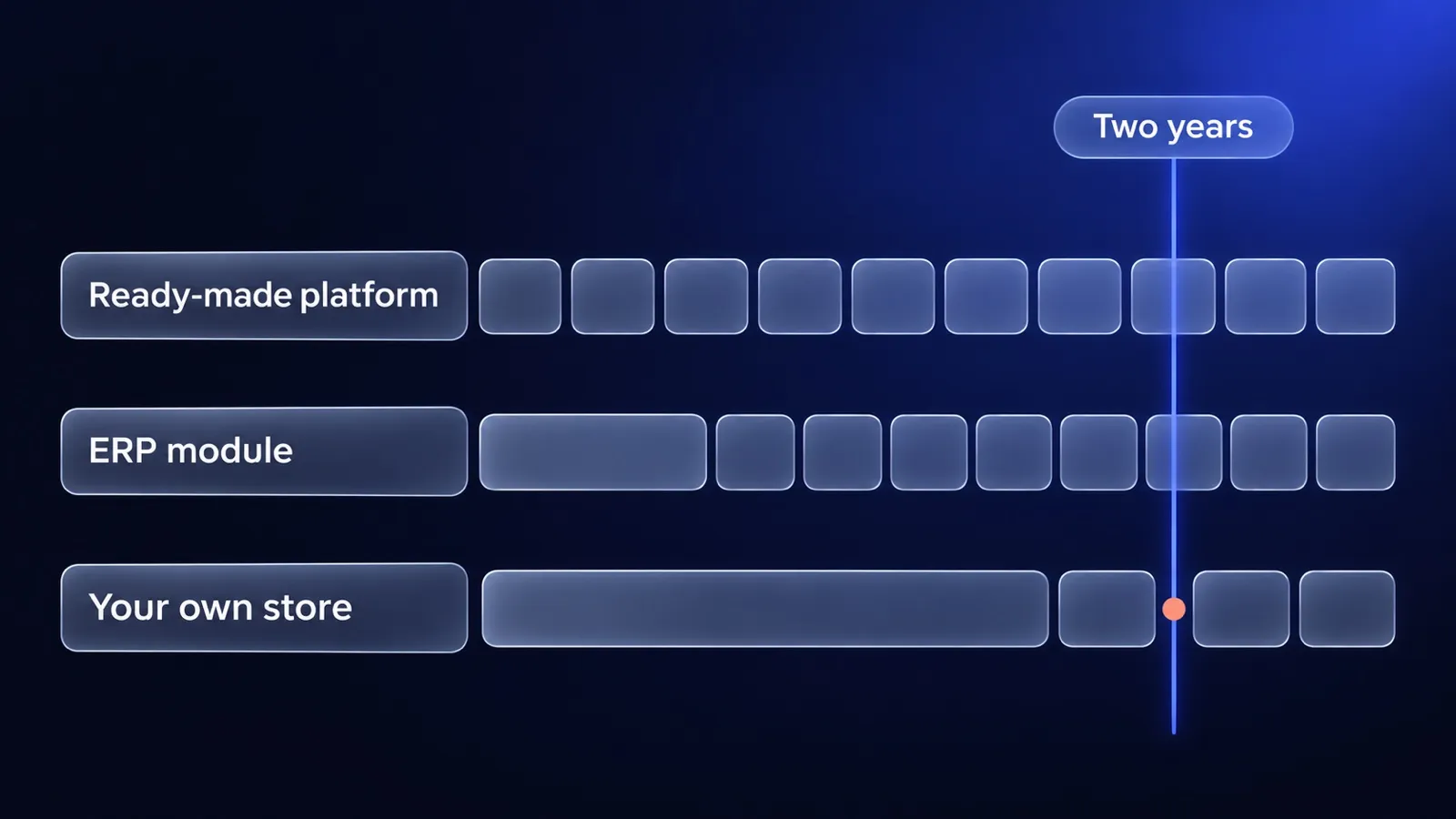
Short answer
A B2B ecommerce platform costs from about €9,900 to more than $110,000 in published fees over 24 months, depending on the route: Shopify Plus lists $2,300 a month (source, as of 2026-11) on a three-year term, BigCommerce’s top plan starts at $1,499 a month (source, as of 2026-11) with B2B Edition quoted on request, and Microsoft lists the Dynamics 365 Commerce e-Commerce add-on at $4,000 per tenant a month (source, as of 2026-11) on top of user licences. A store you own on Medusa starts from €5,000 net to build, about €2,500 net for an ERP integration and €100 net a month. Choose SaaS when a plan below the top tier covers your B2B process, and price your own store when you need the top plan, a B2B add-on and an ERP connector at the same time.
How much does a B2B ecommerce platform cost in 2026?
A B2B ecommerce platform costs an implementation paid once and a monthly fee, and the balance between them depends on the route. The table lists the prices each vendor publishes, with the source and the date we read them.
| Route | Example | One-off | Monthly | ERP integration |
|---|---|---|---|---|
| SaaS B2B platform | Shopify Plus | Agency quote | $2,300 on a 3-year term, $2,500 on a 1-year term (source, as of 2026-11) | Connector app or agency |
| SaaS B2B platform | BigCommerce Performance with B2B Edition | Agency quote | from $1,499, plus B2B Edition on request (source, as of 2026-11) | Connector app or agency |
| ERP vendor’s module | Dynamics 365 Commerce e-Commerce | Partner quote | $4,000 per tenant, plus $210 per Commerce user (source, as of 2026-11) | Native to Dynamics 365 |
| Your own store | Medusa, built by Evelumo | From €5,000 net, live in 30 days | From €100 net for hosting and maintenance | About €2,500 net, fixed after data mapping |
Microsoft bills both Dynamics lines annually and says its prices may differ by country. BigCommerce’s prices are in US dollars, and Shopify publishes the Plus fee in dollars, euros and pounds.
Route 1: a SaaS B2B platform
A SaaS B2B platform is a hosted store whose vendor runs the infrastructure for every customer, with B2B features either on every plan or on the top plan as an add-on. The two names most US and UK buyers compare are Shopify Plus and BigCommerce B2B Edition.
Shopify Plus and Shopify B2B
Shopify Plus costs $2,300 a month on a three-year term in the US and £1,800 a month (source, as of 2026-11) in the UK, according to Shopify’s help center. The same page says larger, more complex merchants may pay a variable platform fee based on revenue, and that the fee differs for B2B and direct-to-consumer orders. Shopify publishes no rate for it.
You do not always need Plus for B2B. Shopify’s B2B plan features page lists companies, net payment terms and quick order lists on every plan from Basic up, with up to three active B2B catalogs below Plus. Plus adds unlimited catalogs, catalogs assigned to a company and deposits. Our guide to Shopify Plus pricing for B2B lists every line, including the variable fee questions to ask.
BigCommerce B2B Edition
BigCommerce’s B2B Edition listing shows custom pricing with “Contact us for pricing” and says B2B Edition takes the BigCommerce Enterprise plan “to the next level”. Since 1 June 2026 that plan is called Performance and has custom pricing starting at $1,499 a month, according to BigCommerce’s 2026 pricing update. Confirm with sales which plan your B2B Edition contract requires.
The same update explains why the self-serve plans are not a cheaper way in for a growing B2B company. Scale costs $299 a month billed annually (source, as of 2026-11), charges 0.9% on GMV above $33,333 a month (source, as of 2026-11) and moves to Performance automatically once trailing 12-month GMV reaches $2 million. Contracted Performance plans are exempt from the Open Payment Provider fee.
Route 2: the ERP vendor’s commerce module
The ERP vendor’s commerce module is a storefront or portal that reads customer prices, stock and documents directly from the ERP, so there is no separate integration project. That is its real advantage, and for a company already running the vendor’s ERP it can be the shortest route to a working B2B store.
Microsoft publishes its prices. Dynamics 365 Commerce costs $210 per user a month (source, as of 2026-11), and the e-Commerce add-on $4,000 per tenant a month, both billed annually. The implementation partner comes on top. Other ERP-bound B2B products, such as Sana Commerce for SAP and Microsoft Dynamics, do not publish prices, as we describe in our comparison of an ERP B2B module and a custom platform.
If you run NetSuite or SAP Business One, ask your partner for the storefront licence and the implementation in one written quote, and put both into the same 24-month table as the other routes.
Route 3: a store you own on Medusa
A store you own is built once on an open-source engine and then costs a fixed monthly fee for hosting and maintenance that does not grow with orders or revenue. We build on Medusa, so the catalog, cart, orders, price lists and customer groups work from day one.
Our live store in 30 days starts from €5,000 net. It covers a B2B and B2C store on one catalog, with company accounts and customer price lists, B2C promotions, payments, shipping, hosting and monitoring. The ERP integration is not part of the starting price: we model it at about €2,500 net and fix the price once the data flows are mapped. Hosting and maintenance start from €100 net a month.
Medusa’s core is open source under the MIT licence, so there is no licence fee and no revenue share. Since 11 August 2026, role-based access control and single sign-on in the admin belong to the Enterprise Edition, which Medusa prices on request. If you need them, they are a cost line outside our starting price. The scope of a B2B build, from company accounts to quick reorder, is on our B2B ecommerce development page.
A 24-month B2B ecommerce platform cost model
On one scenario, the published lines alone range from about €9,900 to more than $110,000 over 24 months. The scenario: a distributor selling $100,000 a month online ($1.2 million a year), around 300 business customers with negotiated prices kept in the ERP, B2B orders paid by invoice on net terms, and three staff who would need Commerce licences on Dynamics. We use published prices and our own arithmetic, and leave unpublished lines as quotes.
| Option | 24 months, published lines | Not included |
|---|---|---|
| Shopify Plus, 3-year term, US | $55,200 ($2,300 (source, as of 2026-11) × 24) | Variable fee if quoted, agency build, ERP connector, apps |
| Shopify Plus, 3-year term, UK | £43,200 (£1,800 (source, as of 2026-11) × 24) | Same as above |
| BigCommerce Performance with B2B Edition | from $35,976 ($1,499 (source, as of 2026-11) × 24) | B2B Edition fee, agency build, ERP connector, apps |
| Dynamics 365 Commerce with e-Commerce add-on | $111,120 ($4,000 × 24 plus 3 × $210 × 24) | Partner implementation, the ERP itself |
| Your own store on Medusa (Evelumo) | from €9,900 (€5,000 build, about €2,500 integration, €100 × 24) | Enterprise Edition licence if needed, scope beyond the starting price |
We do not convert currencies, because each vendor bills in its own. The comparison that matters is structural: on the SaaS and ERP routes, the published lines are only the subscription, and the agency or partner work is still missing. On the own-store route, the build and the integration are already in the number.
That does not make the own-store figure a like-for-like quote for every company. €5,000 is the start of a build for the scope above. Complex pricing rules, several source systems or a migration of order history raise it, and we price those before work starts.
What the model leaves out
- Payments. Every route pays a payment provider. On Shopify Plus, orders through a third-party provider carry an extra 0.20% (source, as of 2026-11), while B2B orders paid by bank transfer on net terms carry none.
- The variable fee and the B2B Edition fee. Both are real and unpublished, so ask for them in writing.
- Your team’s time on workarounds. When the process does not fit the platform, you also pay in salaries. That line has no price list and often decides the result.
Our guide to ecommerce website cost shows the same 24-month method for B2C stores, with a calculator for Shopify.
Why agency price ranges are not a B2B budget
Agency ranges cover every kind of B2B project and do not say what is included, so they cannot replace a quote for your scope. OuterBox, a US agency, puts a B2B, large-catalog or integrated store at $75,000 to $250,000+ (source, as of 2026-11) in its May 2026 guide, without a calculation behind it.
Two quotes for the same B2B platform usually differ in scope, not in day rates. The same decisions move both: how many customers have their own price list, whether the ERP calculates prices, whether B2C runs next to B2B, how many systems exchange data and how much history has to move. How data ownership splits between ERP and store is covered in our guide to ERP and ecommerce.
When a ready-made B2B platform wins
A ready-made platform wins when your B2B process fits its configuration on a plan you can afford for years. In that case we advise against a build, including ours. Choose SaaS or the ERP vendor’s module when:
- a plan below the top tier covers your B2B process, for example three Shopify catalogs are enough for your price lists,
- every price and term lives in the ERP and the vendor maintains a connector to it, or you already run the vendor’s ERP and its module,
- you want the vendor to own hosting, security and upgrades and have no one to own a platform,
- B2B online is an experiment you may stop within two years,
- speed on an existing ecosystem matters more than control over every rule.
For which portal features a dealer network needs first, whichever route you take, see our guide to the B2B customer portal.
When your own B2B store wins
Your own store wins when the ready-made route needs the top plan, a B2B add-on, an ERP connector and agency work at the same time. Typical signals:
- You need B2B and B2C under one brand, and on SaaS that means more catalogs, more stores or more apps. See how B2B and B2C in one store works.
- Every key account has its own price list, and the plan that models them is the most expensive one.
- Fees grow with revenue, through a variable platform fee or a GMV overage, while what you use stays the same.
- The ERP decides prices, stock or credit limits with rules a connector cannot follow, so you need an ERP integration designed around your exceptions.
ImpregnatyBC is a store we built on Medusa for consumers and company accounts in one place, with net prices and volume tiers applied in the cart. Its previous store ran on Shopify.
If two of these signals describe your business, price your own store on the same scope: we launch a B2B and B2C store on Medusa in 30 days, from €5,000 net.
When your own store is the wrong choice
Your own store is the wrong choice when you would pay for flexibility you will not use. Do not build if:
- a plan below the top tier covers your process and you do not expect to outgrow it,
- your ERP data is messy, because any platform will show customers the same wrong prices and stock,
- you have a budget for the build but not for maintenance and development after launch,
- you need role-based access or single sign-on in the admin and do not want to pay for Medusa’s Enterprise Edition,
- nobody in your company will own the store after launch.
How to run the 24-month comparison for your business
You can run the comparison in one afternoon if every option gets the same scenario:
- Write down your numbers: active B2B customers, price lists, products, orders a month, revenue and the two-year forecast.
- Find the plan you will need in a year, not today, including GMV thresholds and the plan the B2B add-on requires.
- Add the ERP integration to every option: connector app, partner project or a separate stage.
- Ask each vendor, agency and partner for written quotes, including the variable fee, the B2B Edition fee and implementation.
- Total 24 months and five years for the two cheapest options, and check where your ERP and current store disagree today, because every mismatch is work on every route.
If the result points to SaaS, buy it and rerun the numbers when you hit the next plan threshold. If it points to your own store, let’s talk about the scope for your first group of customers.
Frequently asked questions
How much does a B2B ecommerce platform cost per month?
It depends on the route. Shopify Plus lists $2,300 a month on a three-year term, or £1,800 in the UK. BigCommerce positions B2B Edition on top of its Enterprise plan, now Performance, which starts at $1,499 a month, plus a B2B Edition fee it quotes on request. Microsoft lists the Dynamics 365 Commerce e-Commerce add-on at $4,000 per tenant a month. A store we build costs from €100 net a month after launch.
How much does B2B ecommerce implementation cost?
SaaS vendors and ERP vendors do not publish implementation prices, so the number comes from an agency or partner quote. OuterBox, a US agency, puts B2B, large-catalog or integrated stores at $75,000 to $250,000 or more. We publish our own starting price: a live B2B and B2C store on Medusa in 30 days from €5,000 net, with ERP integration modelled at about €2,500 net and fixed after data mapping.
Is ERP integration included in B2B platform pricing?
Rarely. On Shopify Plus and BigCommerce, the ERP connection is an app subscription, an agency project or both. An ERP vendor's own commerce module, such as Dynamics 365 Commerce, reads ERP data natively, which is its main advantage, but you pay for that in licences. On a store you own, integration is a separate stage with its own fixed price, quoted once the data flows are mapped.
When is a SaaS B2B platform cheaper than your own store?
When a plan below the top tier covers your B2B process, for example Shopify B2B on Basic, Grow or Advanced with up to three active catalogs, and you have nobody to own a platform. Then the subscription buys hosting, security and a roadmap you would otherwise pay for. Once you need the top plan, a B2B add-on and an ERP connector, the 24-month total usually favours a store you own.
Keep reading
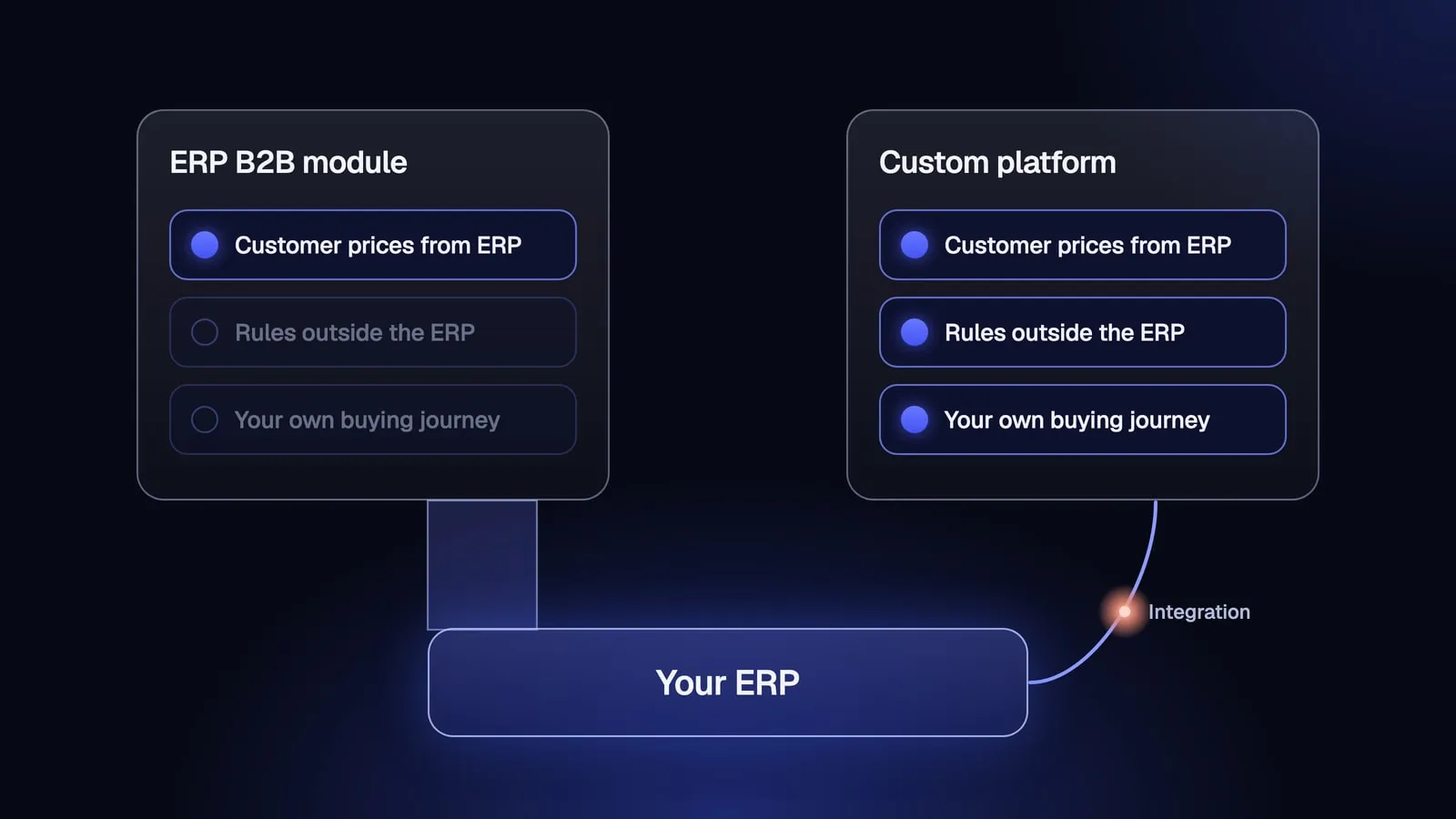
Your ERP vendor's B2B module or a custom B2B platform: which one fits?
Odoo, Dynamics 365 Commerce, Comarch or a custom B2B platform? Compare ERP vendors' B2B modules on price, limits and 24-month cost, and see when custom pays off.
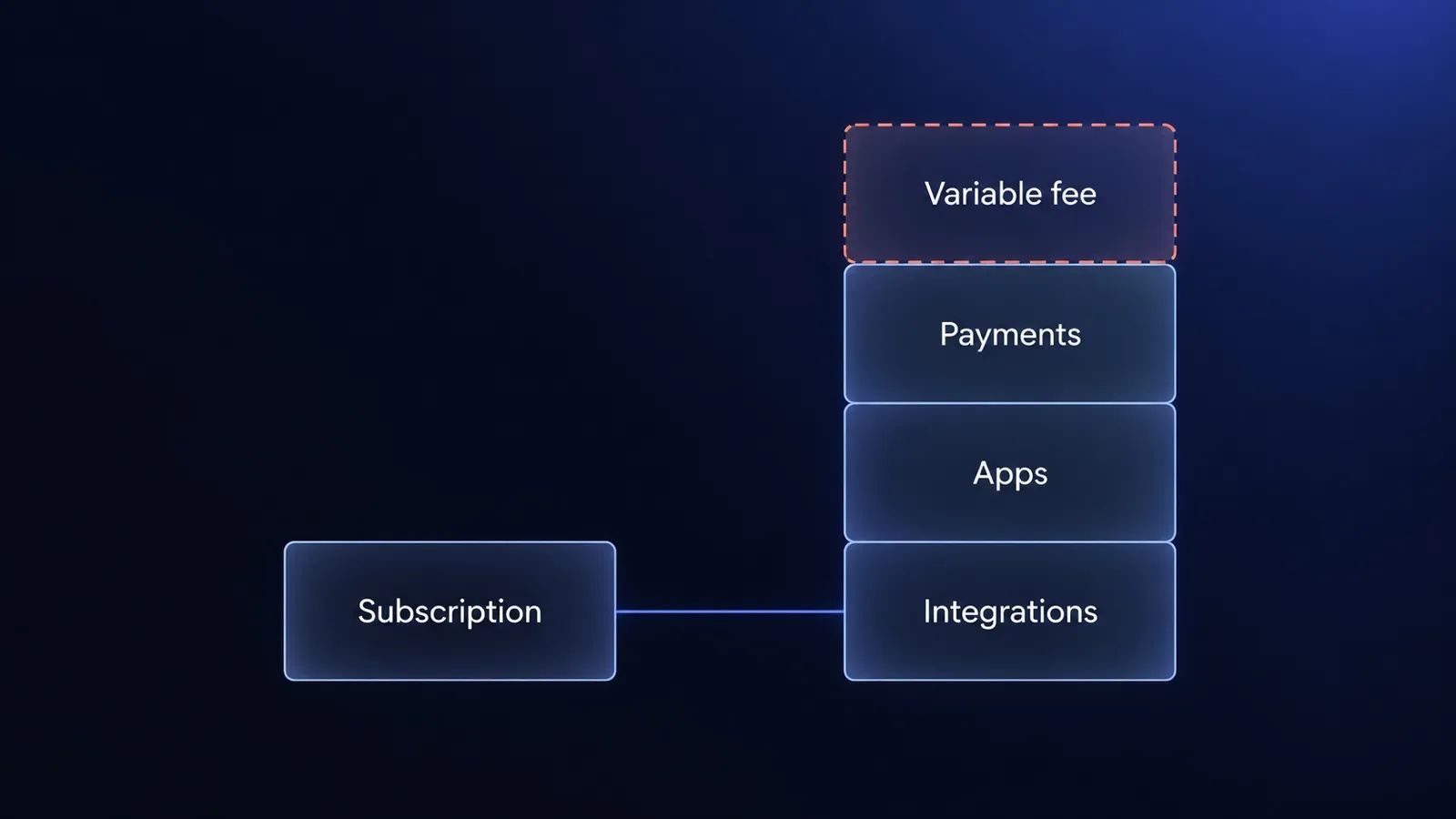
Shopify Plus pricing in 2026: the real total cost for B2B
Shopify Plus pricing starts at $2,300 a month. For B2B, the real cost sits in the variable fee, payments, apps and integrations. What to count before you sign.
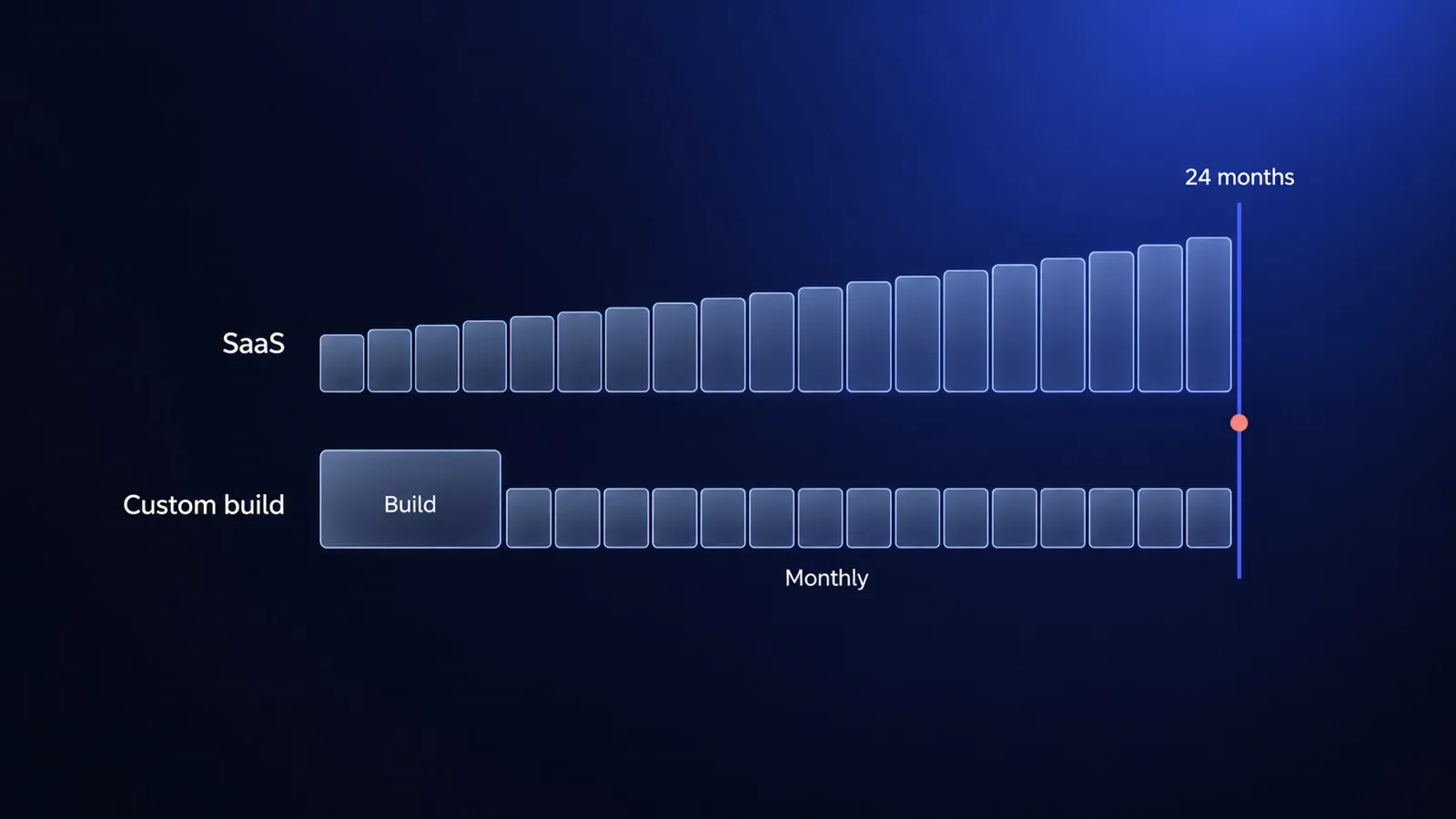
Ecommerce website cost in 2026: SaaS vs custom build, with real numbers
Ecommerce website cost in 2026, using published prices only: Shopify, BigCommerce and a custom build on Medusa compared over 24 months on the same scope.


Questions after reading?
Tell us what the article leaves open for your company. We reply within one working day and prepare a hypothesis before any call.
A question about the article Something does not match your situation, or you want to check an assumption behind a number.
Your own problem Describe the sales process and where your current platform stops being enough.
The next step You are weighing custom, off-the-shelf or a migration and want a second opinion before you commit.