
BigCommerce pricing in 2026: plans, fees and B2B Edition over 24 months
The subscription is the easy part. This guide explains the June 2026 plan changes, how GMV thresholds and automatic upgrades work, when the Open Payment Provider fee applies, what B2B Edition adds, and how to compare 24 months of BigCommerce with a store you own.

Short answer
BigCommerce pricing starts at $29, $79 or $299 a month (source, as of 2026-11) on the Core, Growth and Scale plans billed annually, and Performance starts at $1,499 a month (source, as of 2026-11) billed annually. Since 1 June 2026, the bill also depends on revenue: plans upgrade automatically when trailing 12-month GMV passes the threshold, Scale charges 0.9% on monthly GMV above $33,333, and orders paid through a provider outside BigCommerce’s embedded list, or offline by purchase order, pay an extra 0.6% to 2%. For B2B, B2B Edition is quoted separately, so get that quote before you compare BigCommerce with Shopify Plus or a store you own.
How much does BigCommerce cost in 2026?
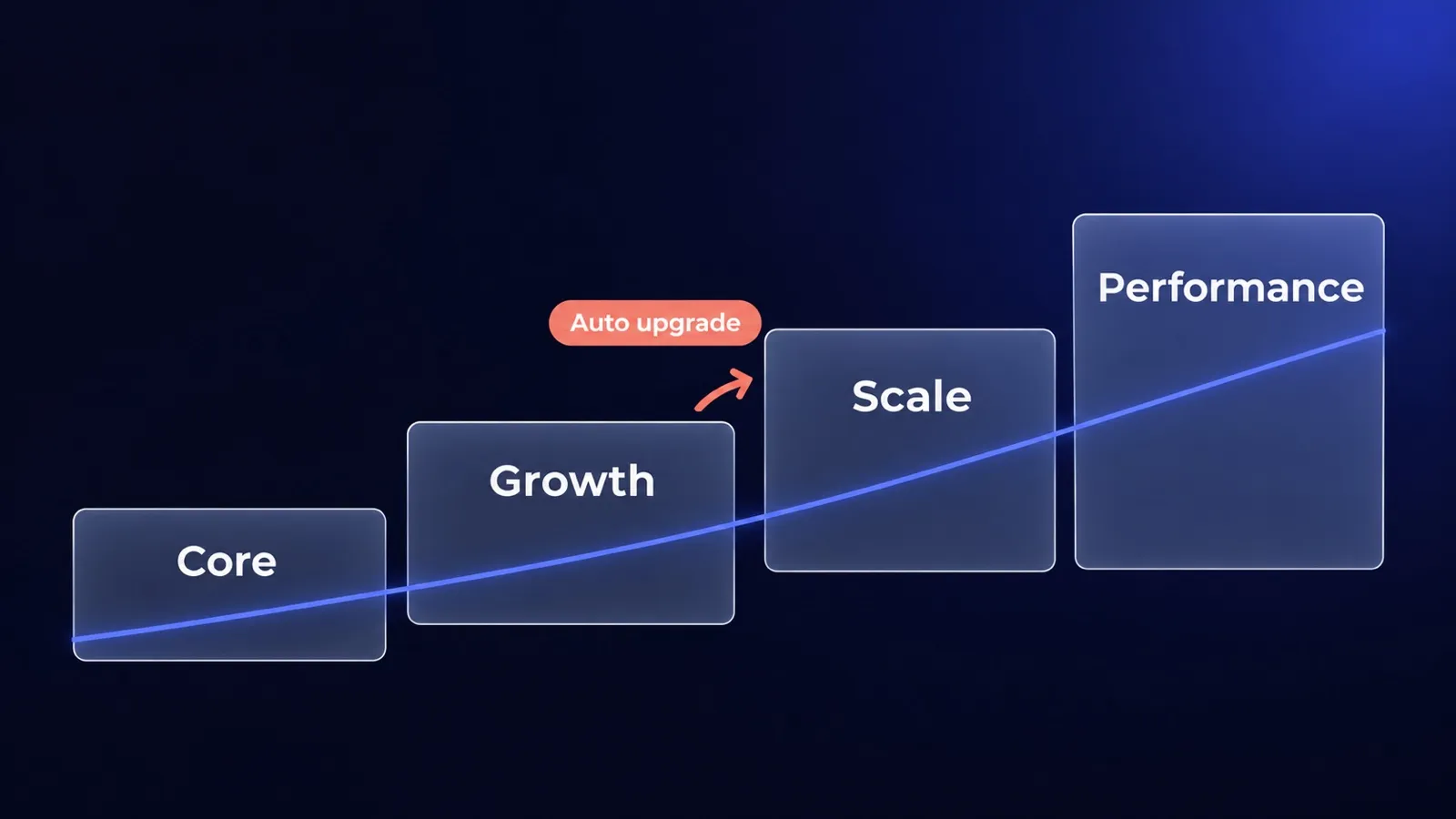
BigCommerce has three self-serve plans with published prices and GMV thresholds, plus a Performance plan with custom pricing. The table lists the figures BigCommerce publishes for the plans that took effect on 1 June 2026.
| Plan (former name) | Billed monthly | Billed annually | GMV threshold | Open Payment Provider fee |
|---|---|---|---|---|
| Core (Standard) | $39 (source, as of 2026-11) | $29 (source, as of 2026-11) | $30,000 trailing 12 months (source, as of 2026-11) | 2.0% (source, as of 2026-11) |
| Growth (Plus) | $105 (source, as of 2026-11) | $79 (source, as of 2026-11) | $100,000 trailing 12 months (source, as of 2026-11) | 1.0% (source, as of 2026-11) |
| Scale (Pro) | $399 (source, as of 2026-11) | $299 (source, as of 2026-11) | $33,333 a month, then 0.9% overage; $2M trailing 12 months (source, as of 2026-11) | 0.6% (source, as of 2026-11) |
| Performance (Enterprise) | Custom | from $1,499 a month (source, as of 2026-11) | $250,000 a month, then 0.6% (source, as of 2026-11) | 0% with a contract (source, as of 2026-11) |
The prices above are in US dollars. BigCommerce runs regional sites, such as its French and Dutch English-language pricing pages, so check the price and currency for your market before you budget. In every threshold, BigCommerce counts “Inclusive GMV”: gross order value minus 10%, according to its pricing page.
What changed in BigCommerce pricing on 1 June 2026?
On 1 June 2026, BigCommerce renamed its plans, lowered the GMV thresholds of the two smallest plans, replaced the Pro plan’s block fees with a gradual overage and added a fee for payment providers outside its embedded list, according to its 2026 pricing update page. The same page says Core and Growth keep the monthly prices of Standard and Plus, and Core no longer includes phone support, which becomes a paid add-on.
The threshold change matters more than the renaming. Core fell from a $50,000 to a $30,000 threshold, and Growth from $180,000 to $100,000, according to the same update page. A store that sat comfortably on the old Plus plan with $150,000 of yearly sales is now past the Growth threshold and moves to Scale.
BigCommerce published its own explanation of the change in Setting the Record Straight. The post disputes a widely shared example of a $2 million merchant paying $40,000 a year in payment fees, arguing that the 2% rate applies only on Core, which a $2 million merchant would never be on. Merchants reacting to the change can be read on the BigCommerce community forum, for example in the thread Why has our pricing increased six-fold in the last month?. Forum posts are individual reports, not BigCommerce’s prices.
How do BigCommerce GMV thresholds and automatic upgrades work?
BigCommerce measures each self-serve store’s trailing 12-month GMV and upgrades the plan automatically when that figure passes the current plan’s threshold. GMV is evaluated on the first of each month, according to the 2026 pricing update. On an annual plan, the upgrade can happen during the paid year: BigCommerce says it gives notice before the change and applies the price difference at the time of the upgrade.
The thresholds turn BigCommerce pricing into a function of sales:
- Up to $30,000 a year: Core is available, at $29 a month billed annually.
- From $30,000 to $100,000 a year: the store must be on Growth or higher.
- From $100,000 to $2 million a year: the store must be on Scale or Performance.
- Above $2 million a year: the store moves to Performance automatically.
- On Scale: every dollar of monthly GMV above $33,333 carries a 0.9% overage (source, as of 2026-11).
All these figures use Inclusive GMV, which BigCommerce defines as gross order value after a 10% reduction, a deduction the June 2026 update raised from 3%. A store with $100,000 of orders a month therefore counts $90,000 toward its threshold and overage. Performance has its own cap, $250,000 a month with 0.6% above it (source, as of 2026-11), on top of the custom contract price.
BigCommerce transaction fees: when does the Open Payment Provider fee apply?
The Open Payment Provider fee applies to orders paid through a provider that is not on BigCommerce’s list of embedded payment providers, and to orders paid outside the platform. BigCommerce says it offers more than 20 embedded providers without the fee, according to its explanation of the June changes, and its pricing page names Stripe, Adyen, PayPal Braintree and BigCommerce Payments among them. Performance plans on contract do not pay the fee. The fee is 2.0% on Core, 1.0% on Growth and 0.6% on Scale (source, as of 2026-11) of eligible order GMV.
The fee is charged on top of the payment provider’s own processing fee, so it is a platform cost, not a card cost. BigCommerce calculates it on Inclusive GMV (gross order value minus 10%) less the GMV paid through embedded providers. A worked example with the published rate: a Scale store with $100,000 of orders a month, all paid outside the embedded list, pays 0.6% of $90,000 to BigCommerce. That is $540 a month, or $12,960 over 24 months, before the provider’s fees.
B2B orders are often paid by invoice or bank transfer, and that is where the fee bites hardest. BigCommerce’s 2026 pricing update says orders processed outside the platform are subject to the fee, including manual and offline payment methods such as purchase orders. A wholesaler whose key accounts pay on 30-day terms pays the fee on those orders even if its card payments run through an embedded provider.
Before you sign, check two things: whether your current payment provider is on the embedded list, and whether your ERP or finance process depends on that provider. Switching provider to avoid the fee is a project of its own when payment reconciliation runs through the ERP.
What does BigCommerce B2B Edition cost and include?
BigCommerce does not publish a list price for B2B Edition. The B2B Edition app listing says to contact BigCommerce for pricing, and the estimates on third-party sites range too widely to budget with. The same listing says B2B Edition takes the BigCommerce Enterprise plan, now Performance, “to the next level”, so the quote may assume Performance rather than Scale. Ask for the B2B Edition fee, the plan it requires and the contract term in one written quote.
B2B Edition adds a B2B layer to a BigCommerce store. BigCommerce’s developer documentation describes company accounts with buyers and roles, a buyer portal, quotes that sales reps can create with additional discounts, and B2B APIs that work only on stores with B2B Edition enabled. According to the same documentation, company accounts are separate from customer groups, and assigning a company to a customer group is optional.
Some B2B pricing features depend on the plan as well as on B2B Edition. BigCommerce’s pricing page lists customer groups and segmentation from the Growth plan up, but Price Lists, described as custom pricing at the SKU level for customer groups, only on Performance. If every key account has its own negotiated prices, ask whether B2B Edition on Scale covers them or whether the quote assumes Performance.
A 24-month cost model for a B2B company on BigCommerce
The model below uses only BigCommerce’s published figures for one example: a B2B and B2C company with $100,000 of orders a month ($1.2 million a year, or $90,000 a month of Inclusive GMV), on the Scale plan billed annually. That stays below the $2 million Scale limit. Lines BigCommerce does not publish stay blank, because inventing them would make the total look precise when it is not.
| Cost line, 24 months | Amount | Source |
|---|---|---|
| Scale plan, billed annually | $7,176 ($299 (source, as of 2026-11) × 24) | Published by BigCommerce |
| Scale overage on Inclusive GMV above $33,333 a month | $12,240 (0.9% (source, as of 2026-11) × $56,667 × 24) | Published by BigCommerce |
| Open Payment Provider fee on orders paid outside embedded providers (including purchase orders) | $0 to $12,960 (0.6% (source, as of 2026-11) × up to $90,000 × 24) | Published by BigCommerce |
| B2B Edition | Ask for a quote | Not published |
| Performance, once trailing 12-month GMV passes $2 million | From $1,499 a month, custom quote | Published as a starting price |
| Apps, theme and agency work | Your own quotes | Depends on scope |
| ERP integration | Your own quotes | Depends on scope |
| Payment provider processing fees | Your provider’s rates | Paid on any platform |
On the published lines alone, the example store pays between $19,416 and $32,376 to BigCommerce over 24 months, before B2B Edition, apps and integration work. The spread depends on how much of the revenue is paid outside embedded providers, and for a B2B company that includes every order paid on invoice terms.
Run the same model on your own numbers. Take 90% of your monthly order value, keep the overage formula (0.9% of the amount above $33,333) and add the B2B Edition quote once you have it. For a store on Shopify, the same method is in our guide to Shopify Plus pricing for B2B, and for the plans below Plus in is Shopify worth it for a growing store.
BigCommerce vs a store you own on Medusa: 24 months side by side
A store you own on Medusa replaces the platform’s subscription, overage and payment-provider fee with a build cost and a monthly maintenance fee. The table compares the cost structure, not a single total, because the BigCommerce side has unpublished lines and the two sides are priced in different currencies.
| BigCommerce Scale with B2B Edition | Your own store on Medusa (Evelumo) | |
|---|---|---|
| Upfront build | Theme and agency work, your quotes | From €5,000 net for a live B2B and B2C store in 30 days |
| Platform fee | $299 a month billed annually | None: Medusa’s core is open source under the MIT licence |
| Revenue-based fee | 0.9% of monthly GMV above $33,333 | None |
| Payment-provider fee to the platform | 0% to 0.6% depending on provider, purchase orders included | None; any provider you integrate |
| B2B layer | B2B Edition, quoted separately | Company accounts, price lists and approvals built in your code |
| ERP integration | Agency or app, your quotes | Modelled at about €2,500 net, fixed after data mapping |
| Hosting and maintenance | Included in the plan | From €100 net a month |
| Who owns the code | BigCommerce owns the platform | You own the store’s code |
For the example company, the BigCommerce lines that are published already reach $19,416 over 24 months before B2B Edition. The Medusa side starts at €5,000 for the build and €2,400 for 24 months of maintenance, plus about €2,500 for an ERP integration as modelled. The Medusa side has its own costs that the table does not hide: Enterprise Edition features such as role-based access control and single sign-on have been licensed separately since 11 August 2026, and every feature you need beyond the starting scope is development work. Our guide to what an ecommerce website costs lists the lines to include.
When BigCommerce is the right choice
BigCommerce is a sound choice when your B2B process fits B2B Edition’s model and your payment provider is on the embedded list. It suits companies that:
- Sell below the Scale overage line, or accept the 0.9% overage as the price of a hosted platform.
- Take payments through an embedded provider, with few orders on invoice terms, so the Open Payment Provider fee stays near zero.
- Fit company accounts, quotes and the buyer portal of B2B Edition without custom pricing logic.
- Have no team to run hosting and updates and want the vendor to own the platform.
- Want to launch on a standard theme quickly and accept the vendor’s roadmap.
When BigCommerce is the wrong choice
BigCommerce is the wrong choice when the costs that grow with revenue, or the B2B rules you need, sit outside what the published plans cover. Watch for these signals:
- Sales growth pushes you up a plan every year, so the platform cost grows with revenue rather than with what you use.
- Key accounts pay by invoice or purchase order, or your provider is not embedded and changing it would break reconciliation in the ERP.
- Every key account has its own price list, and the plan that supports customer-group price lists is Performance.
- ERP rules decide prices, stock or credit limits, and each rule needs an app or agency workaround.
- The B2B Edition quote and the Scale overage together exceed what a store you own costs to build and maintain over 24 months.
If several of these describe your store, compare a migration with staying. Our ecommerce platform migration checklist covers the order of work, and our ecommerce migration services page describes how we move stores to Medusa. If customer-specific prices are the main reason, see how we build B2B ecommerce platforms with customer price lists and connect them to the ERP.
Questions to ask BigCommerce before you sign
Ask BigCommerce sales for written answers to these questions, so your 24-month model has no blank lines:
- What is the B2B Edition fee, on which plan, and for what contract term?
- What will Performance cost us when trailing 12-month GMV passes $2 million, including the 0.6% above $250,000 a month?
- Which plan includes customer-group price lists at the product and variant level?
- Is our payment provider on the embedded list, and how much of our revenue paid by purchase order or bank transfer will the Open Payment Provider fee cover?
- How is trailing 12-month GMV calculated for our store, and which channels count toward it?
Frequently asked questions
How much does BigCommerce cost per month in 2026?
BigCommerce lists Core at $39 a month or $29 billed annually, Growth at $105 or $79, and Scale at $399 or $299. Performance has custom pricing from $1,499 a month billed annually. Each self-serve plan has a GMV threshold, so the plan you can stay on depends on your sales, not only on the features you need. Apps, B2B Edition, payment fees and agency work come on top.
Does BigCommerce charge transaction fees?
Since 1 June 2026, BigCommerce charges an Open Payment Provider fee on orders paid through a provider that is not on its embedded list: 2.0% on Core, 1.0% on Growth and 0.6% on Scale. Offline and manual payments, such as purchase orders, are subject to the fee too, which matters for B2B. Orders through an embedded provider carry no BigCommerce fee, and Performance plans on contract are exempt.
What happens when my store passes the BigCommerce GMV threshold?
BigCommerce upgrades the plan automatically when trailing 12-month GMV passes the threshold: $30,000 on Core, $100,000 on Growth and $2 million on Scale, which moves to Performance. GMV here means gross order value minus 10%. On Scale, GMV above $33,333 a month carries a 0.9% overage. An annual plan can be upgraded during its term, with notice.
How much does BigCommerce B2B Edition cost?
BigCommerce does not publish a list price for B2B Edition: its app listing says to contact sales. Third-party estimates vary too widely to budget with, so ask for the B2B Edition fee in writing, together with the plan it requires, before you compare BigCommerce with Shopify Plus or a store you own. B2B Edition adds company accounts, buyer roles, quotes and a buyer portal.
Is BigCommerce cheaper than Shopify Plus for B2B?
On the published numbers, BigCommerce Scale costs less per month than the Shopify Plus flat fee, which starts at $2,300 a month. The comparison changes once you add the BigCommerce Scale overage, the Open Payment Provider fee if your provider is not embedded, the B2B Edition quote and any plan upgrade forced by GMV. Compare both on the same 24 months, the same sales and the same B2B scope.
Keep reading
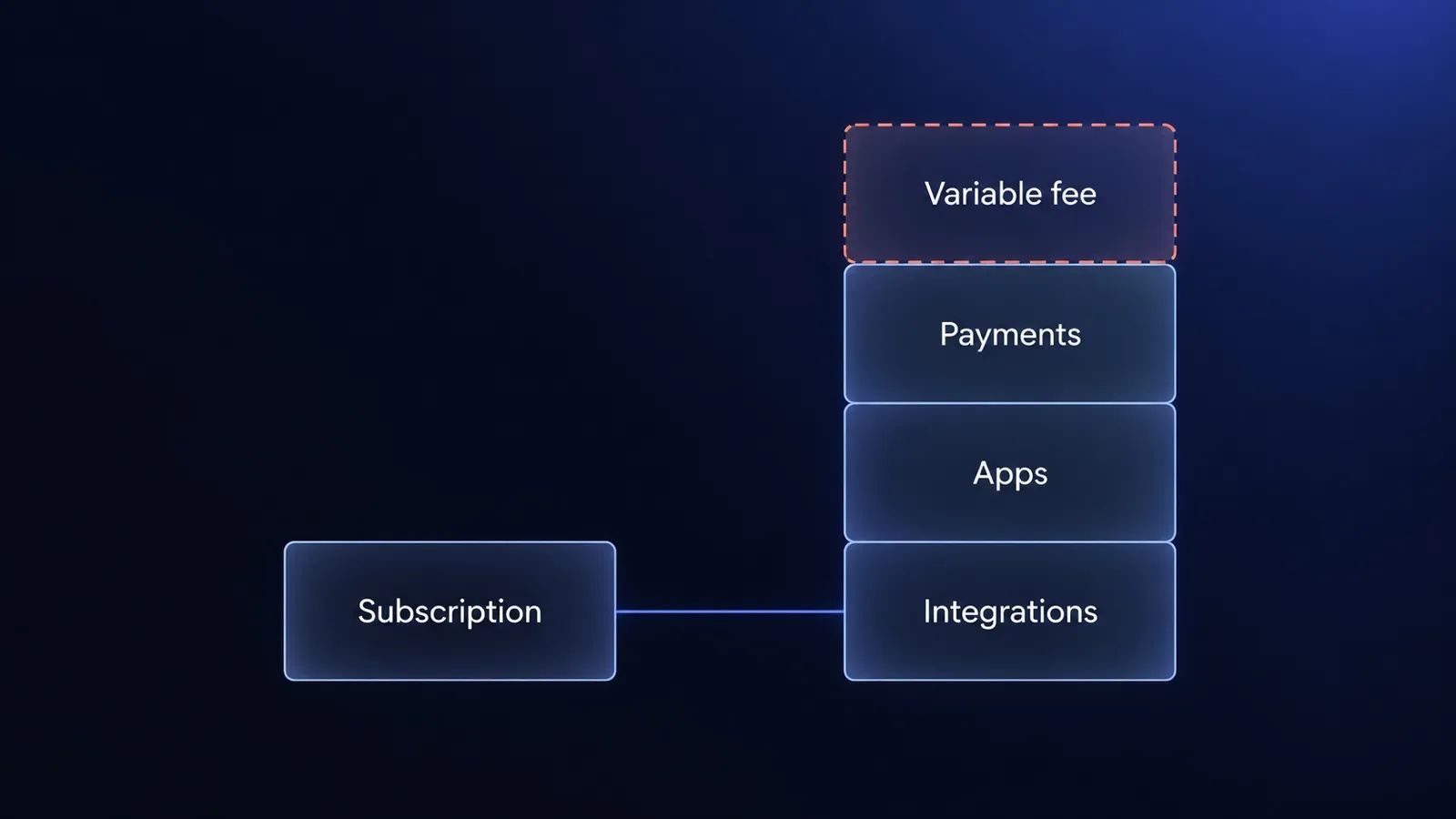
Shopify Plus pricing in 2026: the real total cost for B2B
Shopify Plus pricing starts at $2,300 a month. For B2B, the real cost sits in the variable fee, payments, apps and integrations. What to count before you sign.
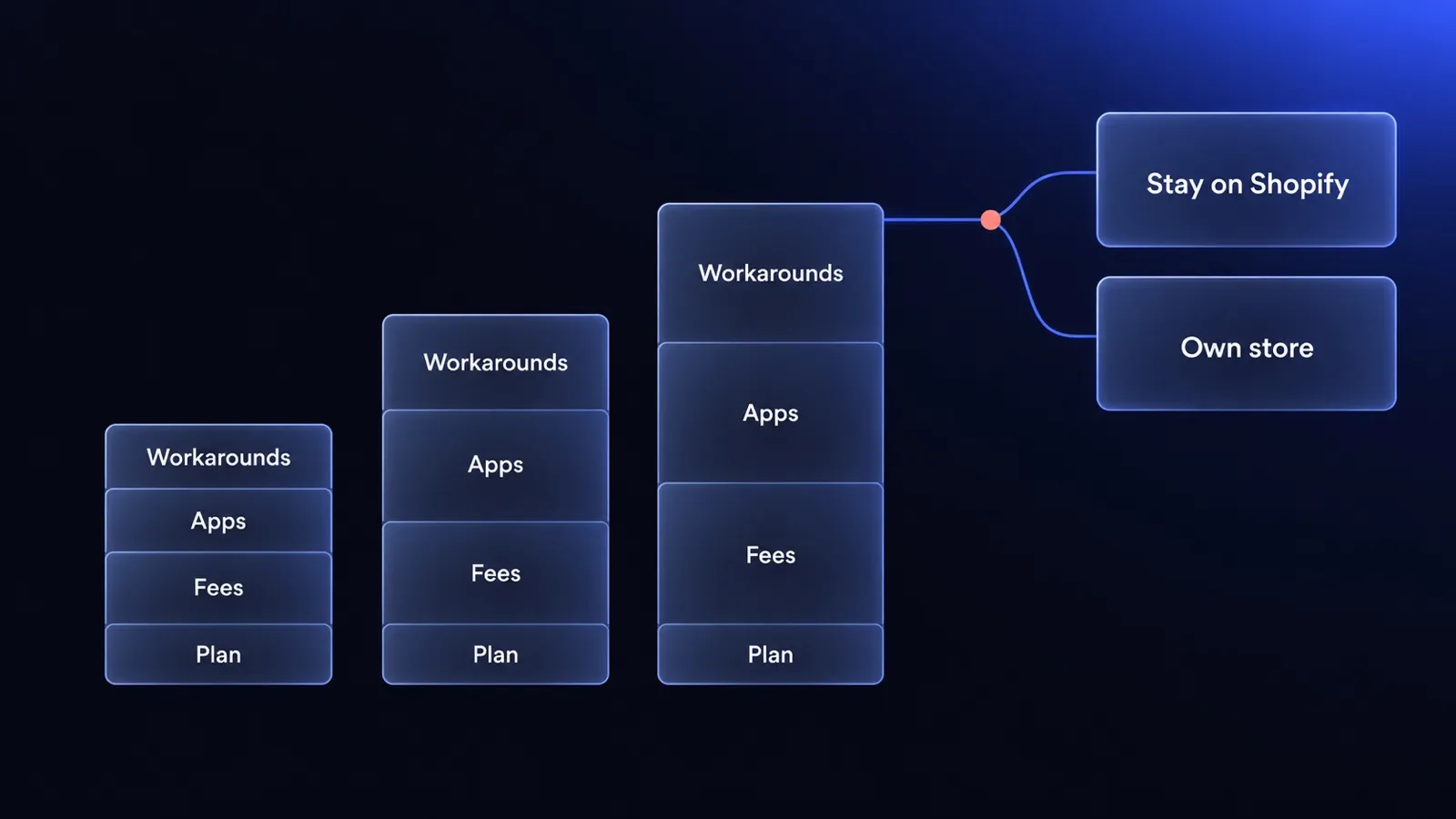
Is Shopify worth it in 2026? When Shopify stops paying off for a growing store
Is Shopify worth it in 2026? For most US stores, yes. See when revenue-based fees, apps and workarounds make it stop paying off, counted over 24 months.
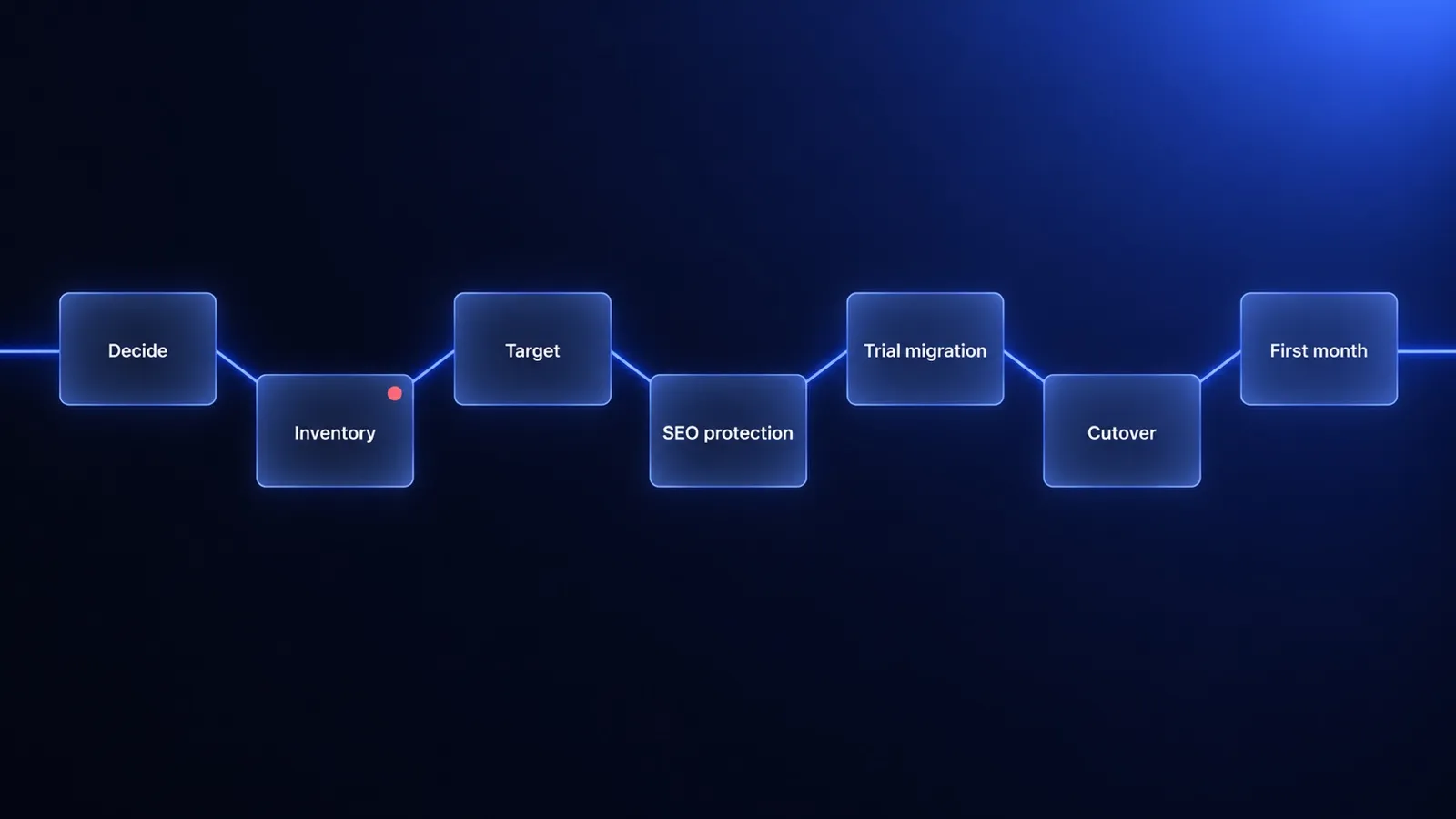
Ecommerce platform migration: a step-by-step checklist for B2B companies
Ecommerce platform migration in seven gates: what to inventory before you choose a target, how to protect SEO with a redirect map, and when to stay put.


Questions after reading?
Tell us what the article leaves open for your company. We reply within one working day and prepare a hypothesis before any call.
A question about the article Something does not match your situation, or you want to check an assumption behind a number.
Your own problem Describe the sales process and where your current platform stops being enough.
The next step You are weighing custom, off-the-shelf or a migration and want a second opinion before you commit.